

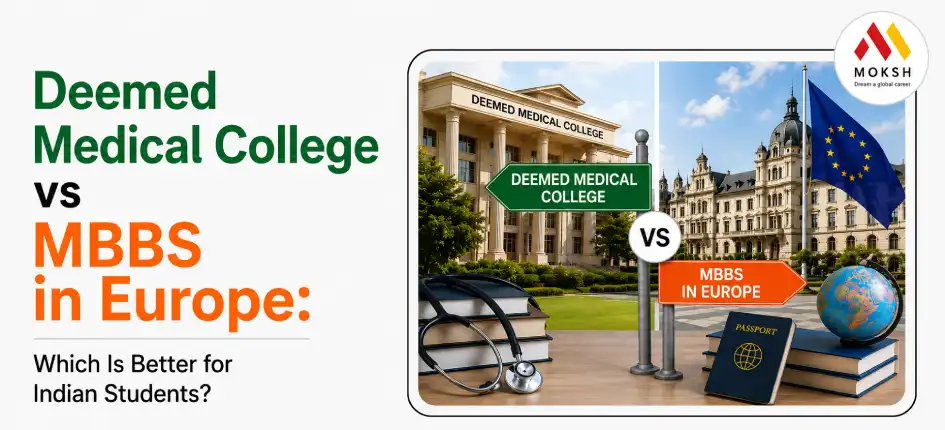
There is a limitation on Government MBBS seats in India. Every year, lakhs of students appear for NEET UG, but only a small number get into government colleges. That leaves two common options: a deemed medical college in India or an MBBS in Europe.
Deemed colleges are expensive. Some charge up to Rs. 1.5 crore for the full course. Europe is being considered more now because some universities carry global rankings and a lower total cost.
But this decision is not just about India vs abroad. It is about cost, NMC rules, clinical exposure, licensing, and MBBS ROI. Making the wrong choice can cost a family years and money.
The preference for Indian NEET students will be based on the student's budget and risk appetite, along with the university's licensing approvals and requirements of the NMC.
Which is the Better Option?
If you want to study and practice in India with minimum licensing complications, the deemed medical college is better. If you are willing to follow the NMC rule strictly, willing to achieve better cost-value and exposure on the international level, then you can opt for MBBS in Europe.
Here is a quick three-point answer:
- Choose a deemed medical college in India if budget is not a major concern and you want Indian clinical exposure.
- Choose a world-ranked European university if you want better cost-value and international exposure.
- Do not choose Europe unless the university is NMC-compliant.
| Best Choice | When It Makes Sense |
|---|---|
| Deemed Medical College in India | High budget, India-focused career, wants Indian patient exposure |
| MBBS in Europe | Wants better ROI, global exposure, and can follow NMC/FMGE/NExT pathway |
| Avoid both blindly | If college or university lacks transparency, hospital exposure, or regulatory clarity |
Deemed Medical College vs MBBS in Europe: Quick Comparison
This table covers the most important factors side by side. Use it to make a faster decision.
| Factor | Deemed Medical College in India | World-Ranked University in Europe |
|---|---|---|
| Total Cost | High; some deemed universities have reported total MBBS costs up to Rs.1.5 crore | Often lower than top-cost deemed colleges; varies by country |
| NEET Requirement | Required | Required for Indian students who want to return and practice in India |
| Degree Validity in India | Indian MBBS pathway | Valid only after meeting NMC rules and clearing licensing requirements |
| Clinical Exposure | Indian diseases, Indian hospitals, Indian patients | Depends on hospital access, language, country, and clinical system |
| Licensing Risk | Lower | Higher if NMC rules are ignored |
| Global Exposure | Limited | Stronger, especially in reputed European universities |
| Best For | Students focused on India | Students seeking global exposure and cost-value |
Some deemed universities have reported MBBS fees reaching up to Rs. 1.5 crore, with annual fees up to Rs. 30.5 lakh in certain cases.
Cost and ROI: Where Does Your Money Work Harder?
MBBS in Europe might provide better ROI than the high fee deemed medical college. However, the following conditions should be met:
- The university is renowned in Europe
- It fulfills NMC standards
- It offers clinical rotation to students
- It trains students to appear for the licensing examination.
Fees at Deemed Medical College can be a significant financial burden for families. Higher fees do not necessarily indicate high quality education/ better PG.
Europe should not be framed as a "cheap MBBS" option. It is an MBBS ROI comparison - cost weighed against real outcomes.
ROI depends on:
- Tuition fees
- Living cost
- University ranking
- Hospital exposure
- FMGE/NExT preparation support
- Postgraduate pathway
Important update: NMC has directed colleges to collect MBBS tuition fees only for the 4.5-year academic period, not the one-year compulsory rotating internship period.
| Cost Factor | Deemed College India | MBBS in Europe |
|---|---|---|
| Tuition Fee | High | Moderate to high depending on university |
| Living Cost | Lower if near home; higher in metro or private hostels | Depends on country and city |
| Hidden Cost Risk | Hostel, security deposits, miscellaneous charges | Visa, insurance, travel, residence permit |
| ROI Question | Is the college worth Rs.70 lakh to Rs.1.5 crore? | Is the university NMC-compliant and academically strong? |
Recognition, NMC Rules and Degree Validity
A European MBBS degree can be useful for Indian students only if it meets NMC foreign medical graduate rules. The university must not be chosen only because it is promoted as "approved."
This section is the most important one. Many families skip this step. That is where problems start.
Indian students pursuing MBBS abroad should verify with these requirements of NMC:
- Medical education of at least 54 months.
- Internship in the same foreign medical institution for 12 months.
- English medium instruction
- Required Medical subjects according to NMC
- Eligible for registration in the country in which the degree is granted
- FMGE/NExT requirement for practice in India
- Supervised internship in India after successfully completing the exam.
| NMC Requirement | Why It Matters |
|---|---|
| 54-month course | Shorter courses may create eligibility problems |
| 12-month internship abroad | Must usually be completed at the same foreign institution |
| English medium | Required for Indian students returning to India |
| License eligibility in that country | The degree must allow practice or registration there |
| FMGE/NExT | Needed for Indian registration pathway |
Critical point: Do not use the phrase "NMC-approved foreign university." NMC does not endorse any list of foreign medical institutions for MBBS or equivalent courses. Always use "NMC-compliant foreign medical university" instead.
Academic Quality and University Ranking
A high ranking is a useful filter. But ranking alone is not enough when choosing a medical university abroad.
Some European universities have strong global rankings. But students must look beyond the rank.
Check these factors before choosing:
- QS Medicine Rankings and Times Higher Education position
- Hospital affiliation and clinical access
- English-taught medicine program
- Clinical training language - class language vs patient interaction language
- Indian student performance and exam pass rate
- FMGE/NExT support provided by the university
QS Medicine Rankings 2026 include nearly 850 universities globally. This makes subject ranking a useful but not final filter for comparing medical education quality.
Times Higher Education 2026 clinical and health rankings evaluated 1,230 universities across 102 countries and territories.
| Ranking Factor | Why It Matters |
|---|---|
| QS/THE Medicine Ranking | Shows academic reputation and research strength |
| Hospital Tie-ups | Determines real clinical learning |
| Medium of Instruction | Must be English for Indian student pathway |
| Local Licensing Eligibility | Confirms the degree has value in that country |
| FMGE/NExT Support | Important for returning to India |
Clinical Exposure: India Advantage vs Europe Advantage
Deemed medical colleges usually offer better Indian patient exposure, while Europe may offer better global exposure. The better option depends on where the student wants to practice after MBBS.
Deemed Medical College India Advantage:
- High patient volume in India
- Familiar disease patterns
- The Indian hospital system experience
- More alignment with the Indian PG exams and practicals
Europe Advantage:
- International hospital systems
- Better infrastructure in reputed universities
- World class exposure to medical procedures.
- Improved academic and research atmosphere at certain universities.
Risk in Europe:
Communication in local language impacts patients' experience. Clinical access varies by country and university. English-taught classes do not always mean English-speaking patients.
Students who plan to practice in India should give serious weight to Indian patient exposure. It directly affects FMGE/NExT preparation and PG entrance readiness.
Career Path After MBBS: India, Europe, UK, US, Germany
For India-focused careers, a deemed medical college has fewer regulatory steps. For global career planning, Europe may be stronger, but only if the student prepares early for licensing and language requirements.
| Career Goal | Better Starting Point |
|---|---|
| Practice in India | Deemed college has simpler pathway; Europe requires FMGE/NExT |
| PG in India | Both need strong exam preparation |
| USMLE/AMC | Europe can offer international exposure, but exam prep matters more |
| Germany or Europe career | European degree may help, but language and licensing are critical |
| Global mobility | Europe may offer broader exposure if university is reputed |
Do not expect direct practice rights in Europe after MBBS. Every country has its own licensing rules. Language requirements, State Medical Council registration and Local Examination are set apart from one another.
Students planning to enter medical professions in an overseas country must do some research prior to making their selection of university.
Who Should Choose a Deemed Medical College in India?
Choose deemed MBBS if:
- Your family can afford the fees without major debt.
- You want to study in India.
- You want Indian clinical exposure.
- You do not want foreign licensing uncertainty.
- You are targeting PG in India.
- You prefer staying close to family.
One caution: Do not choose a deemed college only because it is in India. Before you make a decision, make sure to compare exposures in the hospital, patient volume, faculty quality, PG results, fees and reputation.
Who Should Choose MBBS in Europe?
Consider MBBS in Europe if:
- You are looking for a more cost-effective alternative.
- Your focus is on international job opportunities.
- The university is NMC-compliant.
- The course is taught in English.
- The university has strong hospital exposure.
- You are ready for FMGE/NExT preparation.
- You can adapt to a new country, culture, weather, and language.
Caution: Do not choose Europe only because it is cheaper. Choose it only if the university, country, course structure, and licensing pathway are clear.
Final Verdict
Deemed medical colleges may be a better choice for aspiring medical students seeking a simpler path to obtain an MBBS degree in India, and those willing to pay premium tuition. As long as a university fulfills the requirements of the NMC, a world ranked European university may provide students with higher value, international exposure and wider career routes.
Neither option is perfect for everyone. Both have real costs and real risks.
The right comparison is not India vs Europe. The right comparison is cost vs outcome, recognition vs risk, and degree value vs career pathway.
Choose based on what your family can afford, where you want to practice, and how prepared you are to follow licensing rules. That is the only way to make this decision right.


.png&w=640&q=75)