

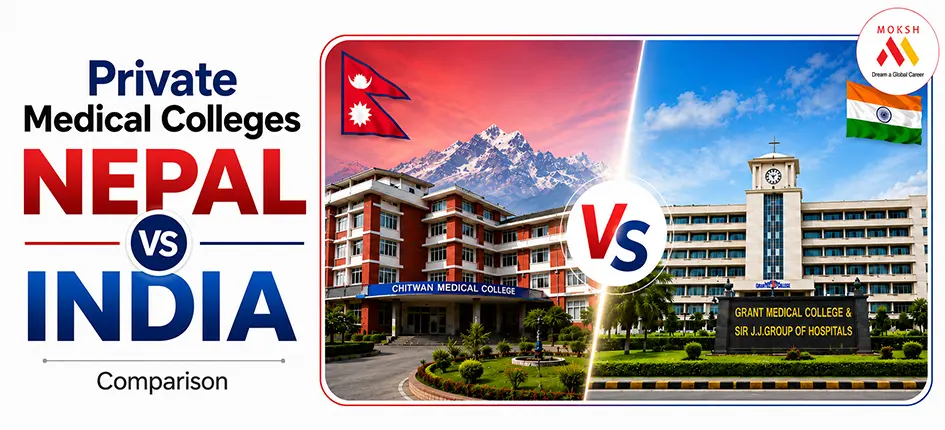
In recent years, pursuing a medical education has become increasingly competitive across South Asia. Aspiring medical professionals often weigh their options between private medical colleges in neighbouring countries like Nepal and India. Both nations have reputable institutions, but each comes with distinct advantages and trade-offs.
In this guide, we compare private medical colleges in Nepal and India across infrastructure, curriculum, faculty, accreditation, cost, and career opportunities - so you can make an informed decision for 2026.
Infrastructure and Facilities
Nepal
Private medical colleges in Nepal have made significant strides in improving infrastructure in recent years. Many institutions now offer modern classrooms, well-equipped laboratories, and access to essential clinical resources. That said, facilities vary more between colleges in Nepal than in India, so it's worth checking a specific college's labs, attached hospital, and equipment before committing.
India
Private medical colleges in India generally have access to larger investment and more established infrastructure. Many institutions have advanced medical equipment, larger campuses, and attached teaching hospitals with higher patient volumes - backed by substantial investment from private trusts and corporate education groups.
Quick comparison
| Factor | Nepal | India |
|---|---|---|
| Cost | Predictable: roughly Rs. 60-70 lakh total | Wide range: Rs. 45 lakh - Rs. 1.5 crore+ depending on quota |
| Competition | Less competitive | Highly competitive |
| Language of Instruction | English | English |
| Degree Recognition | NMC (Nepal) & WHO recognized; FMGE/NExT required to practice in India | NMC (India) recognized; globally recognized for international practice |
| Living Expenses | Lower | Varies significantly by city |
Curriculum and Education Standards
Nepal
Medical education in Nepal follows a curriculum set under the National Medical Education Act, with oversight from the Medical Education Commission (MEC). It includes pre-clinical, para-clinical, and clinical subjects, alongside supervised internships. Standards broadly align with international guidelines, though teaching methods and research emphasis vary across colleges.
India
India's National Medical Commission (NMC) governs the MBBS curriculum nationwide. Indian medical colleges follow a standardized structure covering all major medicine and surgery disciplines, with strong emphasis on clinical exposure, research, and a mandatory rotatory internship - preparing students for India's high-patient-volume healthcare system.
Faculty and Expertise
Nepal
Private medical colleges in Nepal actively recruit experienced faculty, and many have strong Indian-faculty representation, which helps Indian students adjust quickly. Some colleges - particularly newer or smaller ones - can see more turnover in retaining senior faculty compared to larger, more established institutions.
India
Private medical colleges in India typically have access to a much larger pool of experienced doctors, researchers, and academics. Many faculty members are actively engaged in clinical research, giving students more exposure to specialist-level mentorship and ongoing studies.
Accreditation and Recognition
Nepal
Medical education in Nepal is regulated by two separate bodies. The Medical Education Commission (MEC) sets standards for colleges, allocates seats, and conducts the common entrance examination for MBBS admission. The Nepal Medical Council (NMC) separately handles registration and licensing of doctors, and recognizes which colleges meet the criteria to run MBBS/BDS programs. A college's NMC recognition and inclusion in the World Directory of Medical Schools (WDOMS) are the two things Indian students should verify before applying.
India
Private medical colleges in India are regulated by the National Medical Commission (NMC), which replaced the Medical Council of India (MCI) in 2020. The NMC sets standards for infrastructure, faculty ratios, and curriculum, and accredits colleges through its Medical Assessment and Rating Board. Indian private colleges also answer to State Fee Regulatory Committees, which cap and review tuition fees annually - a layer of cost oversight that doesn't have a direct equivalent in Nepal's private college system.
Cost of Education
Nepal
Total cost for MBBS in Nepal - tuition plus hostel and living expenses for the full program - typically runs Rs. 60-70 lakh (roughly $70,000-$80,000), depending on the college and city. Government quota seats (via the MEC entrance exam) are cheaper than direct NEET-based private admission, but seats are limited.
India
Private MBBS costs in India vary far more widely than in Nepal because of quota type and state regulation:
| Seat type | Typical total cost (5.5 years) |
|---|---|
| State quota in private colleges (Kerala, Karnataka, Chhattisgarh, etc.) | Rs. 45-60 lakh |
| Management quota | Rs. 65 lakh - Rs. 1 crore |
| NRI quota / premium deemed universities | Rs. 1 crore - Rs. 1.5 crore+ |
So the honest comparison isn't simply "Nepal is cheaper than India" - Nepal's cost sits in a fairly narrow Rs. 60-70 lakh band, while India's private MBBS cost depends heavily on which quota and state a student can access. A management or NRI quota seat in India will usually cost more than Nepal; a state-quota seat in an affordable state can come in close to or below Nepal's cost.
Opportunities and Career Prospects
Nepal
Graduates from Nepali medical colleges can pursue further specialization, clinical practice, or research in Nepal, India, or abroad - provided they clear the FMGE/NExT exam to practice in India. Nepal's domestic healthcare sector is growing, but most Indian students return to India or pursue opportunities elsewhere after graduating.
India
India's healthcare system offers graduates a much wider range of career paths immediately after graduation - primary care, specialization, public health, research, medical education, and a large medical tourism industry - without the added step of a licensing exam for Indian practice.
Conclusion
Choosing between a private medical college in Nepal and India means weighing infrastructure, curriculum, faculty, accreditation, and cost together - not in isolation. Both countries offer NMC-recognized, WHO-listed pathways to a medical degree, but the trade-offs differ: Nepal offers a more predictable total cost and an admission process built around NEET or the MEC exam, while India offers a larger, more specialized healthcare system at a cost that varies sharply by state and quota.
Because both markets have a fair number of unregistered or unreliable agents, prospective students should verify any study abroad consultant directly with the college before paying any fees.
By weighing these factors and understanding the realities of medical education in Nepal and India, aspiring doctors can make a more confident, well-informed choice.
.png&w=640&q=75)