

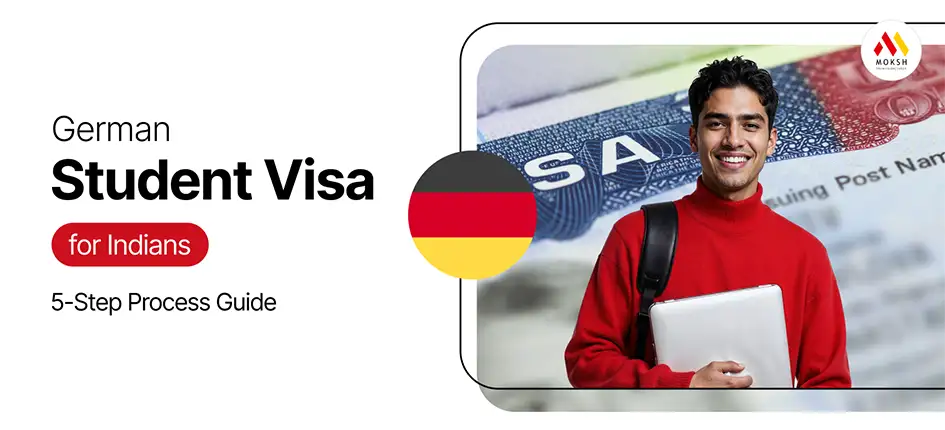
Feeling lost in a sea of confusing visa rules? You're not by yourself. For any Indian student, figuring out how to study in Germany can be a daunting task.
Let's make that change. This guide is your simple, 5-step roadmap to the German student visa process, updated with the current 2026 requirements - financial thresholds, work-hour limits, and visa rules all change periodically, so we've checked each figure below against the latest regulations.
Your Simple 5-Step Pathway to Germany
The journey to study in Germany is easier when you see the clear steps. For Indian students, let's simplify it into a road map.
Your five steps are here:
Follow this pathway to Germany to move from confusion to confidence.
Step 1 & 2: Your Two First Big Tasks - APS & Admission
Let's start with your first two steps. Think of them as the foundation of your study in Germany plan.
1. Get Your APS Certificate (Start This Now!)
The APS certificate is a special document issued by the Academic Evaluation Centre at the German Embassy in New Delhi. It is your mandatory first stamp of approval, proving your Indian school and university degrees are real - without it, neither your university application nor your visa application can move forward.
- Processing typically takes 3 to 4 weeks for Indian applicants, though it can run longer during peak admission season.
- The certificate fee is approximately ?18,000 and is non-refundable.
- Once issued, the digital APS certificate is valid indefinitely.
- 2026 update: for direct bachelor's admission pathways starting Winter Semester 2026/27, APS now requires a minimum of 70% overall marks in Class XII, regardless of board. If you're below this threshold, the Studienkolleg foundation-course route may still be available - check your specific case with APS India.
- Don't wait - even at 3-4 weeks, starting early gives you a buffer against any document queries.
2. Apply to German Universities
Once you start your APS, you can work on your university admission in Germany.
- You will often use a portal called Uni-Assist to apply.
- A good tip is to apply to several public universities.
- This increases your chance of getting an acceptance letter, which you need for your visa.
Finish these two steps, and you are well on your way!
Step 3: Your Proof of Funds - The Blocked Account
This step is about proving you can support yourself. Germany wants to know you have enough money for your living costs.
What is a Blocked Account?
Think of a blocked account in Germany as a secure, special bank account. You put money in it before you go. This acts as your proof of financial means for the visa.
- The current required amount for 2026 is €11,904 per year, released at a monthly withdrawal limit of €992.
- This figure is tied to Germany's BAföG student-support rate and is reviewed periodically, so always confirm the exact current amount before transferring funds.
- You can only take out a limited amount each month for your rent, food, and needs.
Step 4: The Visa Application & Interview
It is time to tie everything together and put it all into action. The secret is in getting your documents straight - and getting it right the first time.
Your Germany Visa Checklist
Collect these valuable papers in preparation for easy filing:
- A valid passport.
- Your APS certificate.
- Your college acceptance letter.
- Proof of a blocked account.
- German health insurance for the student.
- Your CV (curriculum vitae).
- A Statement of Purpose (SOP).
This list of Germany visa documents is your starting document list. Check each item carefully.
Visa Interview Preparation
Be prepared to be questioned on your plans. Here are quick tips:
- Know your study plan. Describe what you are going to learn and why.
- Explain your university choice. Say why you picked that specific program.
- Be clear about your future. You can mention wanting to gain experience, but your main goal is to complete your studies.
Being prepared for these visa interview questions will help you feel confident.
Step 5: Your Future: Work During & After Studies
Your student visa is also the start of your career path in Germany. Here's how it works:
During Your Studies
You can work part-time. As of 2026, the rule is 140 full days (or 280 half-days) per year - this was raised from the earlier 120-day limit in 2024. A great option is a Werkstudent job. This is a working student role in your field. It gives you money and important experience, while staying within your annual day limit.
After You Graduate
You get an 18-month Job Seeker Visa. This is your post-study work visa. It allows time to seek a degree-related job.
Your Long-Term Future
Once you have a qualifying job offer, your path to Permanent Residence (PR) depends on which work permit you hold:
- If you qualify for the EU Blue Card (a recognized degree plus a job meeting the salary threshold), you can apply for PR in as little as 21 months with German at B1 level, or 27 months with basic A1 German.
- On a standard work permit, the usual path to PR takes 5 years.
Most graduates moving into skilled roles after their degree qualify for the Blue Card route, so it's worth checking your eligibility early rather than assuming the faster timeline applies automatically.
You Are Ready for Your Journey
See? The German student visa procedure is easy to follow once you understand each step - and now you have the current 2026 figures to plan around. Your ambition of going to study in Germany is achievable.
Take your next step with confidence. Our experts at MOKSH Overseas Educon know this path well. We help students just like you every day.
Book your Free Consultation today. Let us develop your own version of the action plan.
.png&w=640&q=75)