


The National Medical Commission (NMC) released the final NEET UG 2026 syllabus. It is directly related to Physics, Chemistry and Biology textbooks of NCERT Class 11 and 12. Where to focus might be an issue for you since there is much to be covered.
This guide breaks down the complete syllabus. It highlights the high-yield chapters. This will help you build a study plan around what matters most to rank.
What's New in the NEET UG 2026 Syllabus? Here's the Official Update
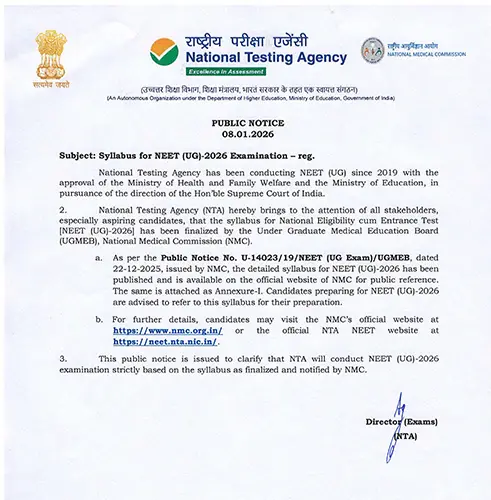
The National Medical Commission (NMC) has formally released the latest NEET UG 2026 syllabus through its Undergraduate Medical Education Board (UGMEB). This is the only official blueprint for your exam.
Strictly NCERT, No Extra Topics
The key update is the syllabus's complete alignment with the NCERT Class 11 and 12 textbooks for Physics, Chemistry, and Biology. The NMC has streamlined the content to focus solely on essential concepts. This implies that you do not have to study any extra syllabus other than that prescribed in NCERT-type syllabus.
Why Following the Official Syllabus is Your #1 Priority
Authority Matters
The NMC is the final authority. Their published syllabus is what the National Testing Agency (NTA) will use to create the exam paper.
Avoid Rank-Harming Mistakes
Using old books or coaching materials that contain outdated or extra topics wastes precious time. That time should be spent mastering the high-yield chapters that actually carry marks.
Focus on clarity
In many applicants, there is a lack of focus. The official update provides clear boundaries, so you can channel your effort efficiently into the right NEET UG 2026 important topics and avoid confusion.
NEET UG 2026 Exam Pattern: Your Marks Distribution Blueprint
Before diving into the chapters, understand the NEET UG 2026 exam pattern. This is your test's master plan. The exam tests you on Physics, Chemistry, and Biology (PCB) with a total of 180 questions worth 720 marks.
Here is the crucial marks breakdown:
| Subject | Questions | Marks | Weightage |
|---|---|---|---|
| Physics | 45 | 180 | 25% |
| Chemistry | 45 | 180 | 25% |
| Biology | 90 | 360 | 50% |
| Total | 180 | 720 | 100% |
This table shows a key strategic point: Biology carries half of your total score. Though Physics and Chemistry carry an equal weight when it comes to competitive classification, this would indicate why your NEET preparation plan should begin with a strong understanding of Biology. This information can help you manage your study time in a reasonable way at the start. Next, we'll break down the exact syllabus for each subject to build your smart study plan.
NEET UG 2026 Syllabus: A Complete PCB Subject Overview
Think of the complete NEET UG 2026 syllabus as your master map. It is divided into the three core subjects: Physics, Chemistry, and Biology (PCB). Each subject draws its content entirely from the NCERT Class 11 and 12 textbooks.
Here is a simple breakdown of the subject-wise syllabus structure:
| Subject | Major Units Covered | Source |
|---|---|---|
| Physics | Mechanics, Thermodynamics, Optics, Modern Physics | NCERT 11 & 12 |
| Chemistry | Physical, Inorganic, Organic Chemistry | NCERT 11 & 12 |
| Biology | Diversity, Physiology, Genetics, Ecology | NCERT 11 & 12 |
This overview shows that the NEET PCB syllabus systematically covers the essential concepts from your two years of study. Physics builds from mechanics to modern concepts. Chemistry is split into its three fundamental branches. Biology extends from the diversity of life to the complex human systems and ecology. This upper-level structure is what one has to understand initially in order to arrange a targeted and efficient study plan to NEET UG 2026.
How to Clear NEET UG 2026 Physics? - Your Guide to High-Yield Chapters
NEET Physics is a challenging subject for many students. Your conceptual knowledge and numerical skills are shown in the Physics exam. Rather than attempting to master it all, it is more intelligent to put all your effort into the chapters that award you the maximum number of marks - the high-yield chapters.
Such subjects are common questions, are the basis of other subjects, and are essential to a high score.
Complete these high-weightage chapters initially, in order to gain confidence and achieve a good score in Physics. A strong hold on these areas forms the core of a smart NEET preparation strategy.
| Chapter | Priority | Why It's Important |
|---|---|---|
| Modern Physics | Very High | This is often the easiest to score from. Questions are typically straightforward and based directly on NCERT facts and formulas. |
| Optics | High | Combines diagrams, formula application, and conceptual questions. A very consistent and scoring section. |
| Current Electricity | High | A favorite for MCQ creators. Focus on circuits, Kirchhoff's laws, and meter bridge concepts. |
| Magnetism & EM Induction | High | Concepts here lead to multiple questions. Understanding magnetic fields and Faraday's law is essential. |
| Laws of Motion | High | The absolute base of Mechanics. You must be strong here to solve problems in other units. |
| Work, Energy & Power | High | Central to physics problem-solving. The work-energy theorem is a powerful tool for many numericals. |
| Rotational Motion | High | While concepts can be tough, this unit has a high number of predictable, repeated numerical problems. |
| Thermodynamics | High | Tests your grasp of laws and cycles through both theory and calculation-based questions. |
How to prepare for NEET UG Physics 2026?
Start your Physics preparation with the "Very High" and "High" priority chapters. Develop their concepts sufficiently, and solve a variety of numerical problems using each one. This narrow plan guarantees that you will get the marks in the most valuable areas, which will make Physics look less threatening and challenging towards NEET UG 2026.
How to Clear NEET UG 2026 Chemistry?
Chemistry can feel like three subjects in one. It includes the logic of Physical Chemistry, the facts of Inorganic Chemistry, and the reactions of Organic Chemistry. This can easily make you confused as to where to spend your time. The smart strategy is not to treat them equally. But identify the high-yield chapters in each branch that deliver the most marks.
The Three Branches
The following are the key chapters under each branch according to the importance in your NEET study.
| Section | Chapter | Priority | Why Focus Here? |
|---|---|---|---|
| Inorganic | Coordination Compounds | Very High | An absolute favorite for question papers. Questions are direct from NCERT. |
| Physical | Thermodynamics & Equilibrium | High | Core concepts that are applied everywhere. Strong here boosts confidence. |
| Physical | Electrochemistry | High | Involves clear concepts and numerical problems that are very scoring. |
| Inorganic | Chemical Bonding | High | The foundation for understanding molecular structure and properties in chemistry. |
| Organic | Hydrocarbons & Carbonyl Compounds | High | These form the backbone of organic reaction mechanisms and essential named reactions. |
| Organic | Biomolecules | High | Directly from NCERT and consistently asked. Focus on carbohydrates, proteins, and nucleic acids. |
How to prepare for NEET UG Chemistry 2026?
Use this list to start your Chemistry review. For Inorganic Chemistry, your best tool is the NCERT textbook. For Physical and Organic, combine NCERT reading with constant problem-solving. With a focus on these high-weightage chapters, you lay a good basis for NEET UG 2026.
How to Clear NEET UG 2026 Biology? - Your 50% Score Strategy with High-Yield Chapters
Biology is half of your NEET score. It has 90 questions (360 marks), and your performance will affect your rank. This makes a smart Biology preparation strategy your most important task. Success comes from two non-negotiable rules: a line-by-line focus on NCERT and mastering diagram-based learning.
Forget extra reference books. The NEET Biology paper is known for testing direct facts and diagrams straight from the NCERT Class 11 and 12 textbooks. Your goal is to know these books inside and out.
Within the vast syllabus, some chapters are consistently more important. These Botany and Zoology high-yield chapters appear every year and carry more weight. Focus your energy here first.
Botany (Plant Biology) High-Yield Chapters
| Unit | Chapter | Priority | Why It's a Scoring Topic |
|---|---|---|---|
| Reproduction | Plant Reproduction | High | A direct, fact-heavy unit from NCERT. Life cycles (like in flowering plants) and diagrams are highly asked. |
| Ecology | Biodiversity & Ecosystem | High | Conceptual and factual. Topics like ecological succession, energy flow, and plant adaptations are regulars. |
| Cell Biology | Plant Cell Structure & Function | High | The foundation. Questions on organelles specific to plant cells (like chloroplasts, cell wall) are common. |
| Biotechnology | Principles & Applications | High | A modern and consistently tested area, especially tools like genetic engineering which are often applied to plants. |
| Genetics | Molecular Basis of Inheritance | Very High | DNA, RNA, and central dogma are fundamental. Plant genetics and related concepts are tested in depth every year. |
Zoology (Animal Biology) High-Yield Chapters
| Unit | Chapter | Priority | Why It's a Scoring Topic |
|---|---|---|---|
| Human Physiology | Breathing, Circulation, Excretion | Very High | The core of human biology. Diagrams (heart, nephron) and physiological processes are question favorites. |
| Reproduction | Human Reproduction | High | A direct, fact-heavy unit from NCERT. Diagrams of reproductive systems and hormonal cycles are highly asked. |
| Genetics | Molecular Basis of Inheritance | Very High | DNA, RNA, and central dogma are fundamental. Human genetics and disorders are tested in depth every year. |
| Cell Biology | Animal Cell Structure & Function | High | The foundation. Questions on organelles, cell division (meiosis/mitosis), and animal tissues are very common. |
| Biotechnology | Principles & Applications | High | A modern and consistently tested area, especially applications in medicine (like gene therapy) and diagnostics. |
How to prepare for NEET UG Biology 2026?
Your Smart Study Priority Order: The High-ROI Strategy for NEET UG 2026
Knowing the syllabus and the high-yield chapters is not enough. A smart NEET study plan follows a simple rule. That is to prioritize chapters that give you the maximum marks for the least effort first. This study strategy is perfect for both beginners and droppers who need to utilize their time wisely.
Follow this three-level framework to build your schedule:
| Priority Level | What to Focus On | Why This Order Works |
|---|---|---|
| Level 1 | High-Yield + Easy Chapters | Start here to quickly build confidence and secure marks. These are your "low-hanging fruit." |
| Level 2 | High-Yield + Moderate Chapters | Once Level 1 is strong, dive into the important chapters that require more time or conceptual depth. |
| Level 3 | Low-Yield + Hard Chapters | Tackle these last. They demand high time investment for relatively fewer marks. |
How to Apply This to PCB?
- For example, in Biology, a Level 1 chapter might be Biotechnology (Applications)- This is the most important topic from NCERT.
- A Level 2 chapter would be Human Physiology - extremely high-yield but requires deeper understanding.
- Level 3 should have the most hard and low-weightage topics.
This way will make sure that you attend to the things that are important in scoring first. Start with Level 1 to build a strong mark base, then progress.
Your Weekly Time Allocation Strategy for Balanced NEET UG 2026 Prep
Creating a smart weekly study plan is the best way to turn your syllabus knowledge into real progress. An obvious error would be to spend time unequally on the three subjects. This would negatively affect your total result. The plan of your time allocation must indicate the exam weightage and personal requirements.
A weekly schedule that allows progress to be regular looks like this:
| Subject | Recommended Time Allocation |
|---|---|
| Biology | 45% |
| Chemistry | 30% |
| Physics | 25% |
Why This Distribution Works?
This division reflects the division of marks in the exam. The allocation of the highest slot to Biology is in line with it being 50% of your score. Chemistry and Physics follow. This ensures that you build conceptual strength without neglecting the high-value biology.
The Revision vs. Practice Balance
Do not use all your time only learning new topics. A realistic rule is to devote approximately 70 percent of your weekly hours to new concepts and problems to practice. The rest 30% should be used to revise actively what was learned in earlier weeks. This process enhances memory and develops long term understanding.
4 NEET UG Mistakes That Can Reduce Your Score
Numerous students work hard, yet they are left wondering why am I getting such a low NEET score. It is often a result of these typical syllabus and preparation mistakes:
Downloadable NEET UG 2026 Syllabus PDF
The official notice will help you realise that millions of students are aware of this update in the syllabus. Make sure you read the whole PDF.
Download NEET UG 2026 Syllabus PDFTake Your Preparation Further with our NEET College Predictor Feature
Planning doesn't stop with the syllabus. As you give mock tests, you will know how much score you are achieving. Get our MOKSH Career Planner App and have an effective NEET college predictor. Just put in your anticipated score and grade to:
- NEET rank predictor by marks and admission probability.
- Government, private, management and NRI college predictions with cut-offs.
- Fee structure of each college.
- Obtain information depending on the state reservation policy.
Download NEET Rank Predictor Now
In Conclusion
You now have the official NEET UG 2026 syllabus and a clear high-yield strategy. The final step is to build your personalized roadmap. If you want expert help to create a tailored study plan, solve tough topics, or navigate your college options, our counselors at MOKSH Overseas Educon are here to guide you.
Book Your Free NEET Guidance Session Now