


Study in English Speaking Countries: Costs, Intakes and Scholarships for Indian Students
Every year more than 1.88 million students from India travel to different countries for higher education. This is second highest after China. Generally, when thinking about study destination for higher education, at times we get trapped in our heads about nations where native understands the English language and countries where their native language is English.
We Indians as a nation are the highest English-speaking individuals in the world; does this mean that we are an English-speaking country? The answer is - No. There is a huge difference between USA and India, USA has adopted English as their primary native language, while Indians understand English but our native language is Hindi (first language), Bengali, Gujrati, Marathi, etc.
The best English speaking countries to study abroad are the USA, the UK, Canada, Australia, Ireland and New Zealand. All six teach in English. All six have globally ranked universities and a post-study work visa. Ireland, Canada and New Zealand usually cost less than the USA and UK for Indian students.
Your budget, your course and your plan after graduation should pick the country. A student who wants a research-heavy MS often looks at the USA. A student who wants a fast one-year master's often picks the UK or Ireland.
This guide covers cost to study in English speaking countries, intakes, scholarships, visa rules and a direct comparison with Europe.

Best English Speaking Countries to Study Abroad
Six countries lead the list. Each fits a different student.
USA
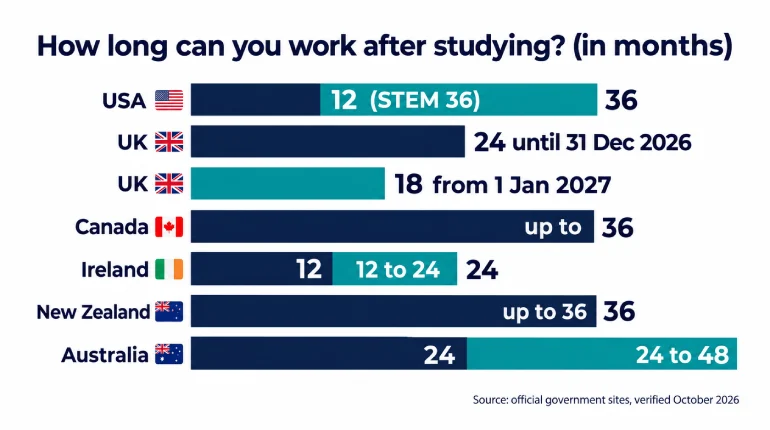
The USA has the most top-ranked universities and the widest course choice. Tuition is high. STEM graduates can work up to 36 months on OPT (12 months plus a 24-month STEM extension). It suits MS in engineering and computer science, research and MBA.
United Kingdom
Most UK master's degrees last one year. That saves a full year of fees and living cost. The Graduate Route visa gives 2 years of work if you apply before 1 January 2027. Applications from that date get 18 months.
Canada
Canada charges lower tuition than the USA and UK. A PGWP can run up to 3 years. Rules are tighter now. A national study permit cap applies, and many applicants need a provincial attestation letter (PAL). Master's and PhD students at public universities are exempt from the cap and the PAL from January 2026.
Australia
Australia is strong in engineering, health and Group of Eight universities. Students can work on a Temporary Graduate visa (subclass 485) for about 2 to 4 years, depending on the degree. Main intakes fall in February and July.
Ireland
Ireland is the only English-speaking country in the Eurozone. Many global tech and pharma firms run European offices there. Graduates can apply for the Stamp 1G permission to stay and work for 1 to 2 years.
New Zealand
New Zealand offers small classes, safe campuses and a calm student life. A post-study work visa of up to 3 years is available, depending on your qualification.
| Country | Typical tuition per year (Rs. lakh) | Work visa after study | Best for |
|---|---|---|---|
| USA | 17 to 45 | OPT, up to 3 years for STEM | Research, STEM, MBA |
| UK | 14 to 32 | 2 years (18 months from Jan 2027) | One-year master's |
| Canada | 9 to 25 | PGWP, up to 3 years | Value and PR pathways |
| Australia | 15 to 30 | About 2 to 4 years | Engineering, health |
| Ireland | 9 to 23 | 1 to 2 years | Budget, tech, Europe access |
| New Zealand | 11 to 22 | Up to 3 years | Quiet, safe study life |
Top Reasons to Study in English Speaking Countries for International Students
As most Asian and African countries established their education system post their independence from Europeans or Americans. Before these countries gained their independence, children of elite families used to study at top universities in Europe and the US. These Universities retained eminent Educationists and Researchers who gave several life-changing discoveries to the world in the field of science and philosophy.
These countries suit international students because every course runs in English. You skip the extra year of language study that some European countries require.
Here are the main reasons students pick them:
Globally ranked universities
Many sit in the QS and Times Higher Education top 100.
Flexible course design
You can often pick modules, co-op placements or internships.
Post-study work visas
Every country on this list has one.
Part-time work rights
Limits differ by country. The UK, Ireland and New Zealand usually allow 20 hours a week in term time. Canada allows 24 hours off campus. Australia allows 48 hours per fortnight.
Merit scholarships
Most universities fund strong applicants.
Mixed campuses
You study with students from 100 or more countries.
English Speaking Countries for Indian Students
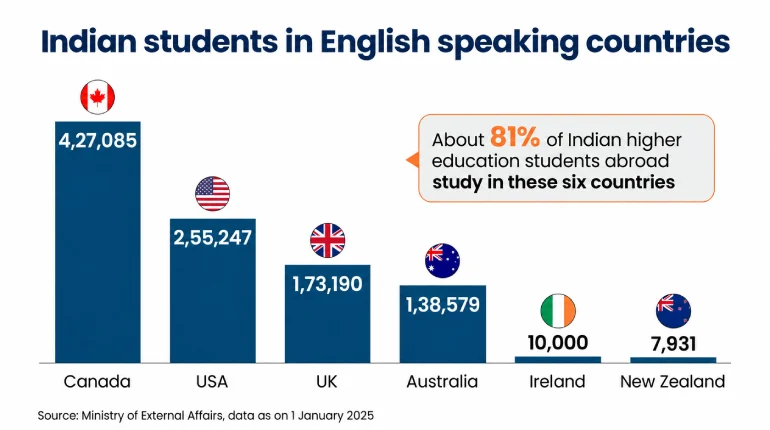
Indian students form one of the largest groups in all six countries.
India is not an English speaking country. English is an official language, but most people speak Hindi, Bengali, Marathi, Gujarati and many others at home. Because of this, universities ask for a proof of English proficiency. Most accept IELTS, TOEFL, PTE or Duolingo. Some waive the test if you hold a Medium of Instruction (MOI) letter.
Which country fits your profile
- Strong GRE or GMAT, wants research or a top MS: USA.
- Wants a short, lower-cost master's: UK or Ireland.
- Wants a clear work and PR route: Canada, with careful course choice.
- Wants engineering or health with a warm climate: Australia.
- Wants a calm campus and smaller budget: New Zealand or Ireland.
Cheapest English Speaking Countries to Study
The cheapest English speaking countries for most Indian students are Ireland, Canada and New Zealand. Ireland often has the lowest total yearly cost because rent and fees run lower than in the UK or Australia.
Two more low-cost options exist:
Malta
English is an official language here. Tuition at many colleges runs lower than in Ireland.
The Philippines
English is widely used in classrooms. It is a popular, lower-cost choice for MBBS. See our MBBS in Philippines page.
How to cut your cost:
- Choose a one-year master's in the UK or Ireland.
- Apply early for merit scholarships.
- Pick a university outside the biggest city. Rent drops sharply.
- Check co-op or paid internship courses.
- Share housing.
Cost to Study in English Speaking Countries
The cost to study in English speaking countries has two parts: tuition and living cost. Total yearly cost runs from about Rs.17 lakh in Ireland to over Rs.60 lakh in the USA at expensive universities.
| Country | Tuition (Rs. lakh/yr) | Living (Rs. lakh/yr) | Total (Rs. lakh/yr) |
|---|---|---|---|
| USA | 17 to 45 | 10 to 18 | 27 to 63 |
| UK | 14 to 32 | 12 to 16 | 26 to 48 |
| Canada | 9 to 25 | 12 to 15 | 21 to 40 |
| Australia | 15 to 30 | 14 to 18 | 29 to 48 |
| Ireland | 9 to 23 | 8 to 12 | 17 to 35 |
| New Zealand | 11 to 22 | 10 to 13 | 21 to 35 |
Costs Students forget
-
Visa and permit fees. Canada's study permit fee is CAD 150.
-
Health cover. The UK charges an Immigration Health Surcharge each year. Australia requires OSHC.
-
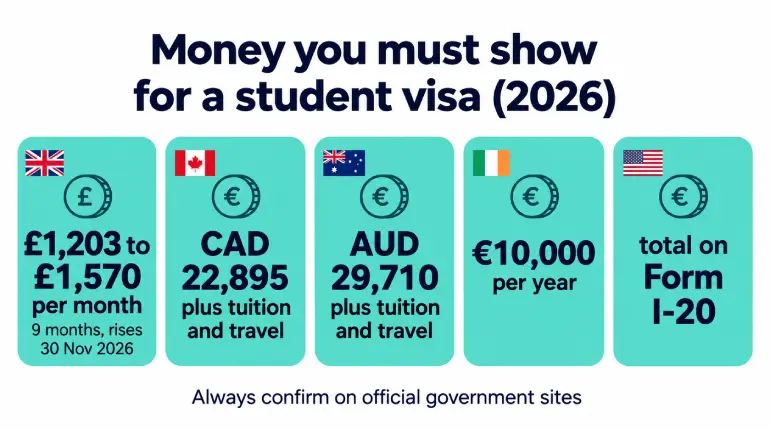
Proof of funds. Canada asks for CAD 22,895 in living funds plus first-year tuition and travel, for a single applicant outside Quebec.
-
Flights, insurance and the first month of rent.
English Speaking Countries in Europe
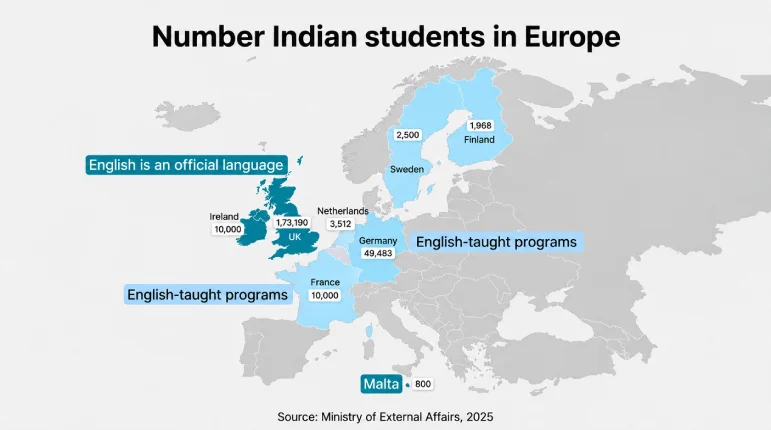
Three European countries have English as an official language: the United Kingdom, Ireland and Malta. In Ireland and Malta, English shares the status with Irish and Maltese.
Several other countries teach thousands of programs in English even though English is not their main language. The Netherlands, Germany, Sweden, Denmark, Finland and Norway all rank high in English skills. Check the latest EF English Proficiency Index for exact scores.
English Speaking Countries vs Europe
Europe usually costs less in tuition. English speaking countries usually offer easier job-market access in English and clearer post-study visas.
| Factor | English speaking countries | Europe (non-English countries) |
|---|---|---|
| Tuition | Rs.9 to 45 lakh per year | Many public universities charge Rs.0 to 8 lakh. The Netherlands, Denmark and Sweden charge more. |
| Language | English everywhere | English programs exist, but daily life needs the local language |
| Post-study work | One country's visa | Each country sets its own rules, usually 1 to 2 years |
| Scholarships | Mostly university and government awards | Erasmus+ and national awards |
| Work with English only | Easier | Harder outside big cities |
English Speaking Countries Intakes
English speaking countries intakes differ by country. September is the main intake almost everywhere. Australia and New Zealand follow a southern calendar.
| Country | Main intake | Other intakes | Start applying |
|---|---|---|---|
| USA | Fall (August to September) | Spring (January) | 10 to 12 months before |
| UK | September | January (some) | 8 to 10 months before |
| Canada | September | January, May | 8 to 10 months before |
| Australia | February to March | July, November | 6 to 8 months before |
| Ireland | September | January (some) | 8 to 10 months before |
| New Zealand | February | July | 6 to 8 months before |
Eligibility and Documents
Each university sets its own rules. Most ask for the following.
Tests:
- GRE or GMAT for many master's and MBA programs (many universities now make these optional).
- SAT or ACT for some US undergraduate programs.
- LSAT for US law schools.
- IELTS, TOEFL, PTE or Duolingo for English.
Documents:
- Passport
- Transcripts for Class 12 and degree
- Statement of Purpose (SOP)
- Letters of recommendation
- Resume or CV
- English test score or MOI letter
- Work experience letters, if any
- Portfolio or research proposal, if the course needs it
- Proof of funds
Student Visa and Post-Study Work Rules
| Country | Student visa | Post-study work |
|---|---|---|
| USA | F-1 (needs I-20, DS-160, SEVIS fee) | OPT, STEM extension |
| UK | Student visa (formerly Tier 4) | Graduate Route: 2 years, or 18 months from 1 Jan 2027. PhD: 3 years |
| Canada | Study permit, often with a PAL | PGWP, up to 3 years |
| Australia | Student visa (subclass 500) | Temporary Graduate visa (485) |
| Ireland | Study visa and IRP card | Stamp 1G, 1 to 2 years |
| New Zealand | Student visa | Post-study work visa, up to 3 years |
Always confirm on official sites: USCIS, GOV.UK, IRCC, Australian Home Affairs, Irish Immigration Service and Immigration New Zealand.
English Speaking Countries Scholarships
Yes, English speaking countries scholarships exist for Indian students. Governments, universities and private trusts all fund them. Most awards go to strong grades, leadership and clear goals.
| Country | Scholarship examples |
|---|---|
| UK | Chevening, Commonwealth Scholarships, GREAT Scholarships |
| USA | Fulbright-Nehru (check current status), university merit aid |
| Canada | Vanier (doctoral), university awards such as the Lester B. Pearson Scholarship |
| Australia | Australia Awards, university merit scholarships |
| Ireland | Government of Ireland International Education Scholarship |
| New Zealand | New Zealand Excellence Awards |
| Indian trusts | Inlaks Shivdasani, JN Tata Endowment, Tata Scholarship for Cornell |
Keep the older scholarship table from the current page, but verify each amount, date and eligibility rule. Add an official link for each one.
Tips for winning:
- Start 12 months before your intake.
- Write a clear, honest SOP.
- Show leadership, research or community work.
Apply to several awards.