

MBBS in Albania - Important Links
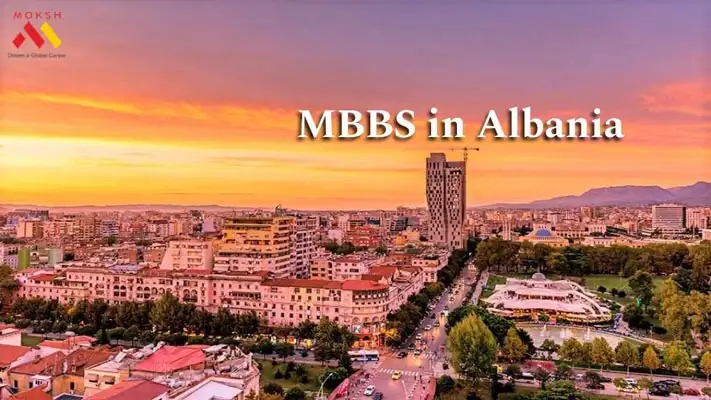
Albania is a country in southern Europe that shares borders with Greece and water bodies with Italy. It is situated on the western side of the Balkan Peninsula, near the Strait of Otranto.
The nation was officially declared independent in 1912. Albanians speak a language known as shqip or shqipe. The Lek is Albania's official currency and has a reasonably advanced healthcare system. The government provides the vast majority of services.
| Degree Name | Doctors of Medicine (MD) equivalent to MBBS |
| Medium of Instruction | English |
| Duration of Course | 6 Yrs. incl. Internship |
| Internship Period | 2 Years |
| License to International Students | Permitted |
| Currency | 1 Lek~0.8 Indian Rupees (INR) |
| Capital | Tirana |
| Population | 2.8 Million |
Education System in Albania
Albania's formal education age is 18 years old. Students who desire to pursue professional degrees, such as those in medicine, engineering, or business, can enrol in institutions in Albania. The table below depicts the four components of Albanian education.
| Education | School/Level | Grades | Age | Years |
|---|---|---|---|---|
| Primary | Basic First Stage | 1–4 | 6–10 | 4 |
| Middle | Basic Second Stage | 5–9 | 11–15 | 5 |
| Secondary | High School | 10–12 | 15–18 | 3 |
| Tertiary | University level | Professional | 19-25 | 6 |
| Tertiary | Doctorate | Speciality | 26-31 | 3–5 |
Both government-run and private higher education institutions are present in Albania. Currently, there are a total of 40 higher education institutions, 15 public and 25 private; there are three universities that conduct medicine programmes in Albania. Of all three, only Western Balkan University accepts all international students and conducts the medicine programme in English.
| University Name | City | Medium of Teaching | Institution Type | Foreign Students |
|---|---|---|---|---|
| Western Balkan Univ | Tirana | English | Private | Admitted |
| University of Tirana | Tirana | Albanian | Public | Only European |
| Our Lady of Good Counsel Univ | Tirana | Albanian& Italian | Private | Only European |
Comparison of MBBS in India and Albania
If we compare the medical education systems of the two countries, it reveals that they are remarkably similar.
| Parameter | India | Albania |
|---|---|---|
| College Type | Public/Private | Public/Private |
| Tuition Fee | Public:1-3 Lacs/Private:60-90 Lacs | 48000 USD~38 LacsINR |
| Duration | 4.5 Years | 6 Years |
| Infrastructure | Good to Avg | Good |
| Internship | 1 Year | Included in 6 Yrs |
| Study Pattern | Asian-Pre, Para & Clinical | European ECTS-based |
| Clinical Exposure | High (Govt)/Avg (Pvt) | High (begins 2nd year onwards) |

Advantages of studying MBBS in Albania
Disadvantages of studying MBBS in Albania for Indian Students
While there are many advantages to studying medicine in Albania, there are also certain challenges. You should also consider the issues listed below regarding Albania when planning to move out.
- Small Indian Community: India's Ministry of Foreign Affairs (MEA) records no more than 100 Indians who work for international corporations, are involved in projects, or are students. This number is low compared to any other nation.
Tuition fee for Medicine program in Albania
The tuition fee in Albania for the Medicine Programme is divided into two parts.
Self-Finance
Students enrolled on this programme must pay the entire tuition fee to the university. All three universities allot seats under the self-finance scheme.
Scholarship Based
Unlike Western Balkan University, the other two universities restrict their scholarship programs solely to European students, as per the terms of the European Education Agreement.
The tuition fee in Albania for the Doctor of Medicine (MD) programme is approx. 8,000 USD for a year for international students.
Cost of Indian Food in Albania
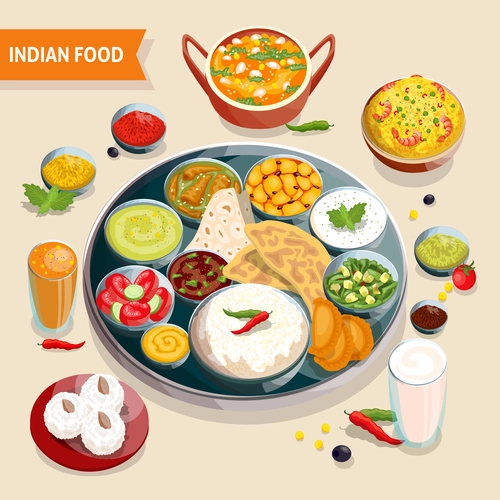
When choosing whether to attend an Albanian medical university, you should consider the availability of Indian food in Albania. Since there aren't many Indian students in Albanian universities, there isn't an Indian mess there. Students who want to eat Indian food may need to prepare food for themselves, costing around 100-120 USD a month.
There aren't many Indian restaurants in Albania, but those that do may charge you the equivalent of 800-1000 INR for a dinner big enough to sustain two people. Likewise, they are ideal for occasional dining.
Hostel facilities in Albanian Medical Universities
Students should not bother much about the accommodations in Albania. Few universities provide dormitories for international students to live in, and they are also quite economical. However, many Indian students may not look forward to this opportunity due to a lack of privacy and cultural differences. Still, it is a good opportunity for those who want to understand the cultures of various ethnicities across the globe. Such dorms cost around 30-40 euros a month.
Staying in a private apartment in Albania is an alternative to a dorm. The cost of a 1-bedroom apartment in Tirana's city centre is approx. 150-200 euros and the same type of accommodation on the outskirts will cost only 100-120 euros. Students can share the apartment to make it affordable for them.
Living Cost in Albania for Indian Students
The cost of living in Albania is very low compared to other European countries. It is slightly higher than the living costs of metro cities in India like Mumbai, Bangalore, and Delhi.
| Expense Type | INR |
|---|---|
| Combo meal (fast food restaurant) | 400-500 |
| 500g of boneless chicken breast | 300-350 |
| 1 litre of whole fat milk | 140 |
| 12 Eggs, large | 250 |
| 1 kg of Tomatoes | 150 |
| 500g of local cheese | 300 |
| 1 kg of apples | 130 |
| 1 kg of potatoes | 80 |
| 2 litres of Coca-Cola | 140 |
| Bread Pack (Big) | 50 |
| Utilities: 1 month for 1 person in 45 m2Studio Apartment | 10000-12000 |
| Monthly ticket public transport | 1000-1200 |
| Standard men's haircut | 400-500 |
Eligibility Criteria for MBBS program in Albania
Admission to MBBS at Albanian Medical Institute for Indian students in 2025 will require
- A student must have 50% in PCB in Class XII
- Must have qualified NEET (category specification applies).
- Age above 17
Admission deadlines for the MBBS program in Albania
For information on the annual intake and application deadline for the Albanian Medical University, see the table below.
| Intake | Month | Last Date to Apply |
|---|---|---|
| Autumn | September 2025 | 1st June 2025 |
| Spring | February 2026 | 15th November 2025 |

MBBS Admission Process in Albania
The admission process for MBBS (Bachelor of Medicine, Bachelor of Surgery) programs in Albania may vary slightly depending on the specific university or institution. Here is a general description of the admissions procedure though:
- Research and Selection: Research and selection are important to make an informed decision, and eligibility criteria must be met.
- Eligibility Criteria: Examine the eligibility requirements established by the university or institution.
- Application: An application form must be obtained from the university's official website or admissions office.
- Documents: Prepare the necessary documents
- Completed application form.
- Academic transcripts and certificates from secondary school or equivalent (Biology, Chemistry, and Physics).
- Proof of language proficiency if the medium of instruction is not your native language. This may require language proficiency test scores or certificates.
- Identification documents (such as a passport or national ID card).
- Passport-sized photographs.
- Any other documents the university specifies, such as recommendation letters (LoR).
- Application Submission: Applications must be submitted within the specified deadline.
- Entrance Examination: Some universities in Albania may require applicants to pass an entrance examination.
- Interview (if applicable): Some universities may conduct interviews during the selection process.
- Selection and Admission: After evaluating applications, entrance examination results, and interviews, the university will announce the list of selected candidates and issue an admission offer letter.
- Confirmation and Enrollment: Once accepted, applicants must pay any required fees and complete the enrollment process within the specified deadline.
Visa Processing in Albania
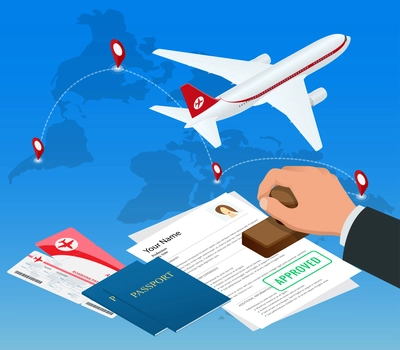
The visa process in Albania varies depending on the purpose of the visit. To determine the type of visa you need, visit the Albanian Ministry of Foreign Affairs website or the nearest Albanian embassy or consulate in your country.
- Application Form: Obtain the visa application form from the Albanian embassy or consulate in your country or download it from their official website.
- Documents: Gather the necessary documents for your visa application, such as:
- A valid passport with at least six months of validity or beyond the intended stay
- Passport-sized photographs
- Completed visa form
- Proof of purpose of visit
- Financial means to support your stay in Albania
- Travel itinerary
- Health insurance coverage.
- The embassy or consulate requires any extra paperwork.
- Submitting the Application: Submit the application and pay the applicable visa processing fee.
- Visa Interview: Show up at the embassy or consulate's visa interview.
- Visa Processing: Visa processing times may vary, so applying well before your intended travel dates is advisable. You may be required to provide additional documents or information during processing.
- Visa Decision: If approved, you may be required to collect your visa from the embassy or consulate or it may be affixed to your passport and returned to you via mail.
PG Options After MBBS in Albania