


Study in Croatia: The Complete Guide for Indian Students (2026-27)
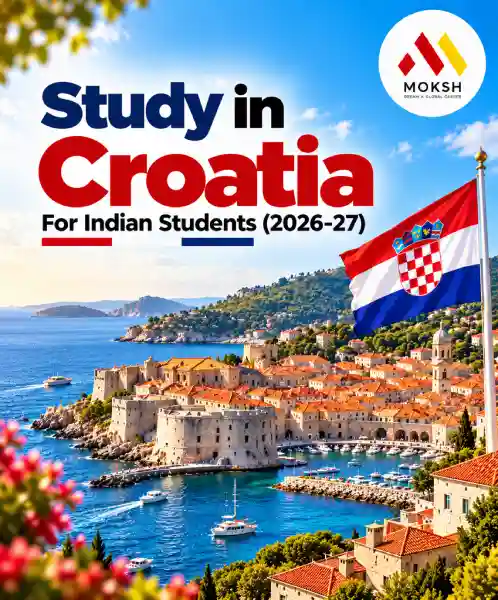
Study in Croatia if you want an EU-recognized degree at a fraction of UK, US or Canadian costs. Croatia offers 1,800+ programs and about 100 are taught in English. Tuition starts near €1,000 a year. Living costs run €400 to €800 a month. Indian students need a D visa and a temporary residence permit for study. Studying medicine in Croatia means a 6-year English MD that costs roughly €9,000 to €12,000 a year. It requires NEET. Graduates who return to India must still pass the NMC screening exam. Croatia suits budget-conscious families who want a Europe-wide career. It has fewer English-taught options than Germany or the Netherlands.
Quick Look
| Fact | Detail |
|---|---|
| EU member since | 2013 |
| Euro and Schengen | January 1, 2023 |
| Programs | 1,800+, about 100 in English |
| Tuition | From €1,000 a year |
| Living costs | €400 to €800 a month |
| Medicine tuition | €9,000 to €12,000 a year |
| Visa | D visa plus temporary residence |
| Work | 20 hours a week via Student Service |
Why study in Croatia for Indian students?
Croatia gives Indian students an EU degree for far less money than the UK, US or Canada. It joined the EU in 2013. It adopted the euro and joined Schengen on January 1, 2023. Its degrees follow the Bologna Process, so your ECTS credits count across Europe.
Cost drives most decisions, so compare the yearly numbers first.
| Country | Tuition per year | Living per month | Post-study route | Job market access |
|---|---|---|---|---|
| Croatia | €1,000 to €12,000 | €400 to €800 | Extension to seek work | EU-wide |
| United States | €25,000 to €55,000 | €1,200 to €2,200 | OPT, H-1B lottery | US only |
| United Kingdom | €18,000 to €38,000 | €1,100 to €1,800 | Graduate Route | UK only |
| Canada | €16,000 to €35,000 | €1,000 to €1,700 | PGWP limits | Canada only |
Indicative ranges. Confirm current fees with each university.
What you get for that price:
Degree portability
A bachelor's takes 3 to 4 years. A master's takes 1 to 2. Both sit inside the European Higher Education Area.
A work route after graduation
Graduates can ask for a one-year stay extension to look for a job. Confirm the rule with the Ministry of the Interior (MUP).
Clear rules
Croatia issues a defined student permit and a defined path to work afterward. Rules change, so verify each step before you pay a deposit.
Best universities and programs in Croatia
The best universities in Croatia for Indian students are the University of Zagreb (IT, medicine), the University of Rijeka (business, medicine), the University of Split (medicine), Algebra University (tech) and RIT Croatia (US-affiliated business and IT). Public universities usually charge less than private ones.
| Institution | City | Type | Strong English programs | Tuition per year | Entry mode |
|---|---|---|---|---|---|
| University of Zagreb | Zagreb | Public | Computing, medicine, dentistry | €2,000 to €12,000 | Exam or transcript review |
| University of Rijeka | Rijeka | Public | Economics, business, medicine | From about €1,061 to €12,000 | Written exam for medicine |
| University of Split | Split | Public | Medicine, economics, maritime | €2,500 to €12,000 | File review and interview |
| Algebra University | Zagreb | Private | Software, cybersecurity, data science | €4,000 to €7,000 | Portfolio or math test |
| RIT Croatia | Zagreb, Dubrovnik | Private, US-affiliated | Business, IT | Check the RIT fee page | Check with RIT |
| University of Osijek | Osijek | Public | IT, agriculture | €2,000 to €4,000 | Transcript merit |
Pick by goal:
- IT and data science: Zagreb's Faculty of Electrical Engineering and Computing (FER) and Algebra University.
- Business and MBA: Rijeka's Faculty of Economics and Business and RIT Croatia.
- Medicine: see the next section.
Most English-taught master's options sit in business and IT. Check each program page for its language, since some courses run in Croatian.
Study medicine in Croatia: MD program, NEET and NMC rules
The 6-year MD program
Studying medicine in Croatia takes six years. That is 12 semesters, 360 ECTS credits and a Doctor of Medicine (MD) title. Years 1 and 2 cover anatomy, physiology and other basic sciences. Years 3 and 4 move you to the bedside in teaching hospitals. Years 5 and 6 bring clinical rotations and a thesis. Zagreb, Rijeka and Split all teach the course in English.
Fees and entry
| University | Fee per year | How you get in | Note |
|---|---|---|---|
| Zagreb | €12,000 | Written exam (Biology, Chemistry, Physics) or transcript review | Fee confirmed |
| Rijeka | Verify, up to €12,000 | Written exam | Optional €800 prep course |
| Split | Verify, up to €12,000 | File review, B2 English, interview | About 70 international seats |
NMC rules for Indian students
The NMC FMGL 2021 rules decide whether India will license you.
| NMC requirement | Croatian standard | Status |
|---|---|---|
| Course of at least 54 months | 72 months | Meets it |
| 12-month internship | Clinical rotations built into the 6 years | Check the same-institution rule in the official curriculum |
| English medium | English lectures, labs, exams | Meets it |
| NEET-UG before enrollment | Required | Mandatory |
| Screening exam in India | FMGE/NExT after you return | Required to practice in India |
Language and EU practice rights
You learn basic Croatian in years 1 and 2, up to about B1 level. You need it to talk with patients from year 3. EU Directive 2005/36/EC gives your degree automatic recognition across the EU and EEA. Each country still sets its own licensing steps and language checks. Graduates can also aim for the USMLE or PLAB routes.
Total cost of the 6 years
Add six years of tuition, living costs, insurance and one-time costs.
Private rent in Zagreb: about €139,880 or Rs.1.25 crore.
University dorm: about €105,000 or Rs.93 lakh.
Rate used: Rs.89 per euro, September 2026. Rerun the math with the fee you confirm and the rate on payment day.
Study in Croatia for international students: admission requirements and how to apply
Most English-taught programs take applications directly at the university. Croatian-language programs use the national Postani student portal. Rules differ by program, so read the faculty page first.
| Level | What you need |
|---|---|
| Bachelor's | Class 12 with the right subjects, English proof |
| Master's | Bachelor's degree, transcripts, CV, motivation letter, references |
| Medicine | NEET, plus Biology, Chemistry and Physics |
Follow these six steps:
- 1
Shortlist programs by fee, city and entry mode.
- 2
Submit your application.
- 3
Get your documents apostilled through India's Ministry of External Affairs, then translated by a certified translator.
- 4
Ask the university if AZVO qualification recognition applies to you. AZVO is Croatia's Agency for Science and Higher Education.
- 5
Take an English test, such as IELTS or TOEFL, if the university asks.
- 6
Accept your offer letter and pay the deposit.
Cost of studying in Croatia: tuition and living expenses
Studying in Croatia costs €1,000 to €12,000 a year in tuition, plus €400 to €800 a month to live, according to the European Commission's Study in Europe profile.
| Field | Tuition per year |
|---|---|
| Humanities, arts, social sciences | €1,100 to €10,400 |
| Natural and technical sciences, IT | €1,000 to €7,000 |
| Business and MBA | €2,000 to €6,000 |
| Medicine and dentistry | €10,200 to €12,000 |
Monthly costs change a lot with your housing.
| Expense | Dorm | Private rent |
|---|---|---|
| Rent | €70 to €135 | €270 to €600 |
| Utilities | Included | €50 to €100 |
| Food | €150 to €250 | €200 to €300 |
| Transport pass | About €11 | €11 to €20 |
| Health insurance (HZZO or private) | €30 to €65 | €30 to €65 |
| Personal spending | €100 to €150 | €150 to €200 |
Dorm living lands near the low end of the range, about €360 to €610. Private rent in Zagreb pushes costs toward the top and sometimes past it. Dorm beds are limited, so apply early.
Budget about €2,000 for one-time costs. Those cover the application fee (€60 to €300), visa, apostille and flights.
Example: A student picks a 2-year IT master's at €4,000 a year and spends €600 a month. Tuition is €8,000. Living is €14,400. Add €2,000 in one-time costs. The total is about €24,400 or roughly Rs.22 lakh at Rs.89 per euro.
Study in Croatia for Indian students: visa and residence permit
Indian students need a D visa to enter Croatia, then a temporary residence permit for study. Croatia issues the permit as a biometric card. Confirm current rules with the Croatian embassy in New Delhi and the Ministry of the Interior (MUP).
| Step | Action | Timing |
|---|---|---|
| 1 | Get your offer letter and pay the tuition deposit | Before you apply |
| 2 | Apply for the D visa at the Croatian embassy in New Delhi. Ask if an outsourced center handles it. | Start 2 to 3 months before travel |
| 3 | Enter Croatia and register your address with the police | Within 3 days |
| 4 | Give biometrics at the police station | Within 30 days of D visa issue |
| 5 | Receive your permit, valid 1 year and renewable | After approval |
Dorms usually handle the address registration. Landlords may not, so ask yours.
Gather these documents:
- Passport valid three months past your stay
- Offer letter
- Proof of accommodation
- Proof of funds
- Health insurance of at least €30,000
- Apostilled police clearance certificate
- Passport photo
- Fee receipts
Croatia's means of subsistence regulation sets student funds at about 25 percent of the average monthly salary, roughly €360 a month, per a 2026 guide. Other sources quote higher yearly totals. Ask the embassy for the exact figure and the accepted forms of proof before you move money.
MUP lists a €46.45 fee for temporary stay and €31.85 for the permit card. It adds a €9.29 administrative fee. Confirm the visa fee with the embassy.
A 2026 change lets a student permit run up to three years. You must send proof of enrollment each year by October 31. Verify this with MUP.
Scholarships

Options for Indian students are limited, so plan to self-fund.
- Croatian Government bilateral scholarships.
- Erasmus+.
- University merit waivers.
Work and post-study options
| Rule | Detail |
|---|---|
| Term time | Up to 20 hours a week through Student Service (Studentski servis) |
| Holidays | Full-time |
| Wage | About €6 to €6.50 an hour, per 2025 and 2026 sources. Verify. |
| Approval | Rules can vary, so confirm with your university |

After graduation, you have three routes:
One-year extension to seek work
Request it at least 60 days before your permit expires.
EU Blue Card
for highly qualified workers.
Long-term residence
after five years of continuous lawful stay.
Student wages help with rent and food. They will not cover tuition.
Conclusion
Study in Croatia if you want an EU degree, a low bill and a career that can reach across Europe. Skip it if wide English-program choice matters most to you. Shortlist two programs, open their fee pages and email each international office this week.