

Quick Answer
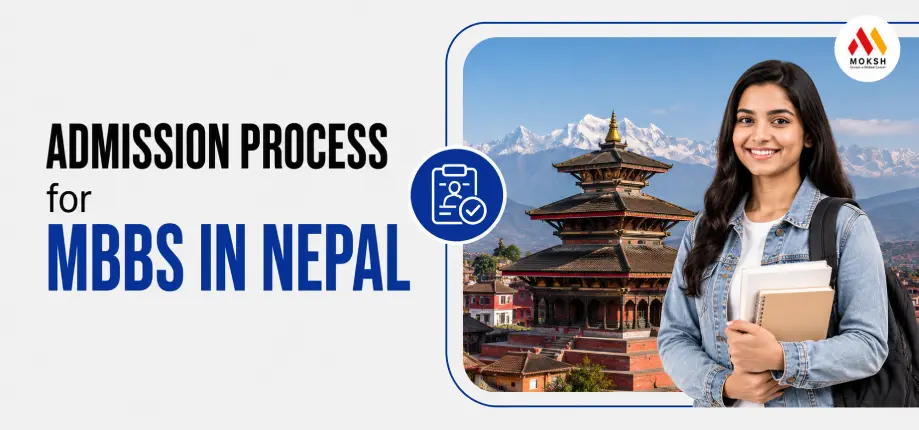
For MBBS admission in Nepal in 2026-27, Indian students need to: (1) qualify NEET-UG 2026 with at least the 50th percentile, (2) complete 10+2 with minimum 50% in Physics, Chemistry, and Biology, (3) register and clear the MEC Common Entrance Exam (CEE) conducted by Nepal's Medical Education Commission, and (4) attend centralised counselling for seat allocation. No IELTS or TOEFL is required. Total fees across private colleges range from ?40 to ?65 lakhs. Degrees are valid in India after clearing NExT - provided the college is NMC-approved and listed in WDOMS.
Why Nepal Still Makes Sense for MBBS in 2026
Let's be honest - the MBBS abroad landscape has gotten more complicated in recent years. New NMC advisories, stricter NExT rules, and a flood of consultants pushing every country under the sun. So where does Nepal actually stand in 2026?
Still strong. Here's why.
Nepal sits right next to India, teaches in English, has no visa requirement for Indian nationals, and its private medical colleges are NMC-approved. That combination is hard to beat - especially when you compare it to the language barrier in Kazakhstan or the sheer distance of the Philippines. Students who did their homework and picked reputable Nepali colleges have generally had a smooth path to clearing NExT and practising in India.
That said, it's not for everyone. The fees at private colleges have climbed. Government seats are nearly impossible to get as an Indian student. And you still need to clear NExT after returning. Going in with realistic expectations makes all the difference.
Here's a quick snapshot of the numbers for 2026-27:
Eligibility Criteria for MBBS in Nepal 2026-27
Before anything else - check whether you actually qualify. Missing one condition can get your application rejected at any stage, and that's a frustrating situation to be in after months of preparation.
| Criteria | What's Required | Status |
|---|---|---|
| Academic Qualification | 10+2 or equivalent with Physics, Chemistry, Biology, and English | Mandatory |
| PCB Marks | Minimum 50% aggregate in PCB (45% for reserved categories) | Mandatory |
| Age | At least 17 years old by 31st December 2026 | Mandatory |
| NEET-UG 2026 Score | Minimum 50th percentile (approx. 164/720 for General category) | Mandatory for Indians |
| MEC CEE Qualification | Must register and appear for Nepal's Medical Education Commission entrance exam | Mandatory |
| English Proficiency | English as a subject in 10+2 is enough - no external test needed | No extra exam |
| Visa | Indian students do not need a visa to enter Nepal | Not required |
No NEET = No Recognition in India
This is the rule that trips up a lot of students. As per NMC India's current regulations, any Indian student pursuing MBBS abroad - Nepal included - must have a valid NEET-UG score from the same academic year of admission. If you skip NEET or don't meet the cut-off, your Nepali degree won't be recognised for NExT, and you won't be able to practise medicine in India. There are no exceptions to this.
Step-by-Step Admission Process for MBBS in Nepal 2026-27
The admission process is actually more straightforward than most students expect - no donations, no opaque selection, no "management quota" drama in the formal channel. It's merit-based throughout. Here's how it works, step by step.
Clear NEET-UG 2026 (India)
Your MBBS journey in Nepal begins in India - with NEET. Secure at least the 50th percentile (roughly 164 out of 720 for General category students). Your NEET score stays valid for three years for studying abroad, so if you appeared in 2024 or 2025 and qualified, that scorecard still works. Keep it ready - colleges and MEC will ask for it upfront.
Register for MEC CEE 2026 (Nepal's Entrance Exam)
The Medical Education Commission of Nepal conducts the Common Entrance Examination (CEE) - this is the national test that determines your rank and, through counselling, which college you get into. Registration typically opens around May-July. Watch the official MEC Nepal website for exact dates, or connect with a MOKSH counsellor who tracks these timelines every cycle.
Prepare for and Appear in MEC CEE
The MEC CEE covers Physics, Chemistry, Biology, and English - very similar to NEET in structure and difficulty. If you've been sincerely preparing for NEET, you don't need to start from scratch. Focus on past CEE papers, practice under timed conditions, and aim for a rank that gives you a genuine choice of colleges - not just any college.
Shortlist NMC-Approved, WDOMS-Listed Colleges
Once you know your CEE rank, shortlist colleges. The single most important filter: is the college listed on wdoms.org (World Directory of Medical Schools)? If it isn't there, don't apply - your degree won't count in India no matter how good the campus looks. After that, compare fees, clinical hospital strength, location, hostel quality, and faculty credentials.
Attend Centralised Counselling Conducted by MEC
MEC holds centralised counselling after CEE results are declared. Seats are allotted purely on CEE rank - no backdoor, no "special consideration." You'll choose your preferred college during counselling based on availability against your rank. Attend all scheduled rounds and carry both originals and photocopies of your documents on counselling day.
Accept the Seat and Pay Initial Fee
Once you're allocated a seat, you usually have 3-5 days to pay the initial admission fee and confirm your place. Miss that window and the seat goes to the next student in line. Don't delay. Get the fee transferred, collect the receipt, and secure your joining letter from the college.
Submit Documents for Verification
The college will require you to physically submit original documents for verification before your admission is finalised. This includes marksheets, NEET scorecard, birth certificate, passport or ID, and a character certificate from your last institution. Get everything attested and organised well before the reporting date.
Travel to Nepal and Report to College
Indian nationals do not need a visa for Nepal - your Aadhaar card, voter ID, or passport is enough at the border. Report to the college on the designated joining date, complete your enrollment formalities, get your library card and ID, and settle into the hostel. Classes typically begin within a week of joining.
NEET vs MEC CEE - What's the Difference?
Students often mix these two up - which is understandable, because both are entrance exams related to MBBS in Nepal. But they serve completely different purposes, and you need both.
| Parameter | NEET-UG (India) | MEC CEE (Nepal) |
|---|---|---|
| Conducted by | National Testing Agency (NTA), India | Medical Education Commission (MEC), Nepal |
| Who must appear | All Indian students - non-negotiable as per NMC | All students applying to Nepali medical colleges |
| Subjects | Physics, Chemistry, Biology | Physics, Chemistry, Biology, English |
| Score validity | 3 years for studying abroad | Valid for that admission cycle only |
| Medium | English + regional languages | English |
| Purpose | Eligibility for NMC recognition of your foreign degree | Seat allocation in Nepal's medical colleges |
| Minimum needed | 50th percentile, General category | Merit-based rank; higher rank = more college options |
Documents Required for MBBS Admission in Nepal 2026-27
Start gathering these now - not two days before the deadline. A few of these take time to get (like migration certificates from your board), and scrambling at the last minute is how students end up losing their seat.
- Class 10 marksheet and passing certificate (original + 2 photocopies)
- Class 12 marksheet and passing certificate with Physics, Chemistry, Biology clearly shown
- NEET-UG 2026 scorecard (or valid 2024/2025 scorecard within 3-year validity)
- MEC CEE 2026 scorecard and rank letter
- Birth certificate as age proof
- Valid passport (6 months+ validity) OR Aadhaar / voter ID for Indian nationals
- 6-8 passport-size photographs (white background, 3.5x4.5 cm, 70% face coverage)
- Character certificate from your last attended school or college
- Migration certificate issued by your education board
- Medical fitness certificate from a registered physician
- Category certificate (SC/ST/OBC) if applicable
MBBS Fees in Nepal 2026-27 -Full Cost Breakdown for Indian Students
This is usually the part where students and parents have the most questions - and the most confusion, because quoted fees sometimes hide costs. So here's an honest breakdown of what you're actually looking at for the full 5.5 years.
| Cost Head | Approximate Amount | Notes |
|---|---|---|
| Total Tuition Fee | Rs. 40 - Rs. 65 Lakhs | Entire 5.5-year course; varies significantly college to college |
| Hostel / Accommodation | Rs. 8,000 - Rs. 15,000 per month | Most colleges have on-campus hostels; some have sharing options that cost less |
| Food / Mess | Rs. 4,000 - Rs. 7,000 per month | Indian food is widely available near most campuses; mess food is often included |
| Books and Study Material | Rs. 20,000 - Rs. 40,000 per year | Standard medical textbooks; PDF versions available for most subjects |
| Personal and Miscellaneous | Rs. 3,000 - Rs. 6,000 per month | Transport, mobile, recreation, occasional travel home |
| Total All-Inclusive Estimate | Rs. 52 - Rs. 78 Lakhs | Full 5.5-year estimate including living costs |
Top NMC-Approved Medical Colleges in Nepal for 2026-27
Not all medical colleges in Nepal carry the same weight. The list below includes colleges that have consistently held NMC approval and are WDOMS-listed - the two non-negotiables. Always double-check their status on wdoms.org before you finalise anything, because recognition statuses can change between cycles.
| College | University Affiliation | Location | Recognition |
|---|---|---|---|
| Institute of Medicine (IOM) | Tribhuvan University | Kathmandu | NMC + WHO |
| B.P. Koirala Institute of Health Sciences (BPKIHS) | Autonomous | Dharan | NMC + WHO |
| Kathmandu Medical College (KMC) | Tribhuvan University | Kathmandu | NMC + WHO |
| Manipal College of Medical Sciences | Kathmandu University | Pokhara | NMC + WHO |
| National Medical College (NMC), Birgunj | Tribhuvan University | Birgunj | NMC + WHO |
| KIST Medical College | Tribhuvan University | Lalitpur | NMC + WHO |
| College of Medical Sciences (COMS) | Tribhuvan University | Bharatpur | NMC + WHO |
Is MBBS in Nepal Worth It in 2026? Pros and Cons
Here's a balanced view - because every student's situation is different, and what works brilliantly for one person might be the wrong call for another.
Genuine Advantages
- No visa needed for Indian students
- NMC + WHO recognised colleges
- English medium throughout
- No IELTS or TOEFL required
- Similar culture, food, and festivals
- Strong clinical exposure in teaching hospitals
- No capitation fees or donations in formal process
- Living costs lower than most cities in India
Real Considerations
- Private college fees: Rs. 40-65 lakhs
- Must clear NExT to practise in India
- Government seats nearly inaccessible for foreigners
- PG options in Nepal are limited
- Need BOTH NEET and MEC CEE
- Currency rate shifts can affect remittance costs
Planning Your MBBS in Nepal for 2026-27?
Get personalised guidance on college selection, MEC CEE registration, document checklist, and financial planning from MOKSH experts who've helped thousands of students navigate this exact process.
Final Word
Nepal remains one of the more sensible MBBS-abroad choices for Indian students in 2026-27 - not because it's the cheapest or the easiest, but because the fundamentals are solid. NMC-recognised colleges, English-medium teaching, no visa friction, and genuine clinical training at affiliated hospitals. That's a combination that holds up.
What trips students up is skipping the basics - not verifying WDOMS listing, not preparing adequately for MEC CEE, or underestimating the importance of NExT preparation early in the MBBS course. Get those right, choose your college carefully, and Nepal can genuinely be the starting point for a strong medical career in India.
If you have specific questions about the 2026-27 cycle - timelines, college comparisons, or financial planning - the MOKSH team can walk you through it without any pressure or sales pitch.
.png&w=640&q=75)