

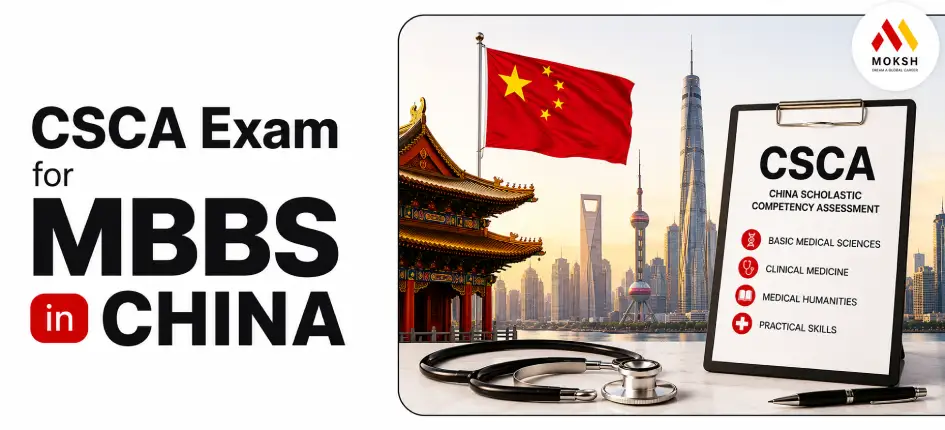
The China Scholastic Competency Assessment (CSCA) is an undergraduate entrance exam issued by the China Scholarship Council. The Chinese Government Scholarship undergraduate program made this exam mandatory for Indian students applying for MBBS in China. And it will expand to all self-funded applicants by 2028.
English-medium MBBS applicants must take Mathematics and Chemistry. The single biggest challenge for Indian students is the compulsory Math section, since most MBBS aspirants come from the PCB stream and have not studied Math since Class 10. Passing the CSCA alone does not guarantee the right to practice medicine in India. NMC compliance is a separate, parallel requirement that governs your entire six years.
What is the CSCA Exam and Why Does It Now Apply to You as an Indian MBBS Applicant?
The China Scholastic Competency Assessment is a standardized entrance exam run by the China Scholarship Council (CSC). It replaced the old system of document-based, qualitative evaluations. Instead of submitting school certificates and hoping for the best, you now sit a structured test that measures your actual academic readiness.
Right now, the CSCA exam 2026 is mandatory for all students applying through the CSC scholarship MBBS pathway. If you are a self-funded applicant, the mandate is being phased in. All self-funded undergraduate applicants will be required to take it by 2028.
Here is everything you need to know at a glance.
| Parameter | Detail |
|---|---|
| Administering Body | China Scholarship Council (CSC) |
| Exam Format | MCQ, single correct answer |
| Scoring | 0-100 per subject, no universal pass mark |
| Fees | CNY 450 (1 subject) / CNY 700 (2+ subjects) |
| Test Windows | January, March, April, June, December |
| Score Validity | 2 years from test date |
Also read- MBBS in China
Which Subjects Does an Indian MBBS Applicant Actually Need to Take?
There are four subjects in the CSCA: Professional Chinese, Mathematics, Chemistry, and Physics. You do not need all four.
If you are applying to an English-medium MBBS program, Professional Chinese is exempt. You will not be tested on it.
For the CSCA subject combination for MBBS, the rules are straightforward.
| Subject | MBBS Requirement | Medium |
|---|---|---|
| Mathematics | Compulsory | English |
| Chemistry | Compulsory | English |
| Physics | University-dependent | English |
| Professional Chinese | Exempt (English-medium MBBS) | - |
Mathematics and Chemistry are compulsory for every English-medium clinical medicine China applicant. Physics is required only at certain universities. Ningxia Medical University is the most prominent example that requires all three science subjects.
One important warning: do not register for subjects you do not need. Each additional subject increases your fee and your preparation burden. Check your target university's requirements before you finalize your subject selection.
How Hard is the CSCA Exam for Someone from the Indian Education System?
The CSCA exam difficulty is closer to the SAT than to NEET or JEE. It tests secondary school fundamentals. It is not designed to eliminate applicants. It is designed to give Chinese universities a common baseline to compare students from different education systems around the world.
There is no single, universal passing score. Each university sets its own CSCA minimum score threshold. Here are two real benchmarks:
- Competitive scholarship universities typically expect 70 or more points per subject.
- Zhengzhou University, a Project 211 institution, requires self-funded MBBS applicants to score at least 50 points per subject.
So the exam itself is manageable. The real challenge is not the level of difficulty. It is the fact that most Indian MBBS aspirants are PCB students who have not touched formal Mathematics since Class 10.
How Can Indian PCB Students Clear the CSCA Mathematics Section Without Studying Math for 2+ Years?
This is the most important section in this guide for most Indian readers. Here is the context.
The Indian school system forces a binary choice in Class 11. You either take the PCM stream (Physics, Chemistry, Mathematics) or the PCB stream (Physics, Chemistry, Biology). Almost every student who wants to become a doctor picks PCB. That means most Indian MBBS applicants have had no formal Math training for two years or more by the time they apply.
The CSCA math for PCB students challenge is real. But it is solvable. The CSCA mathematics syllabus 2026 is divided into four modules. Each module has a different weight and a different level of difficulty for someone from the PCB stream CSCA India background.
| Module | Exam Weight | PCB Strategy |
|---|---|---|
| Sets and Inequalities | 15% | High priority. Venn diagrams and algebraic inequality transformations are quick to learn. This is the fastest module to master. |
| Functions | 35% | Highest weight. Selective focus only. Prioritize sequence formulas and basic trigonometric identities. Avoid complex calculus topics. |
| Geometry and Algebra | 30% | Focus on coordinate formulas for lines and circles. Basic vector algebra and complex number arithmetic only. |
| Probability and Statistics | 20% | High yield. Mean, variance, and normal distribution. These concepts overlap directly with data interpretation in medical sciences. |
Key prioritization note: PCB candidates should build their preparation around Sets and Inequalities and Probability and Statistics first. These two CSCA math modules together account for 35% of the exam. They are the most accessible for someone who has been away from math for years. Once these are solid, move to selective topics in Geometry and Functions.
For students who genuinely cannot manage direct CSCA Math preparation in the time available, there is another route. Foundation program pathways exist at approved universities. This is covered in the university section below.
What is the Full CSCA Chemistry and Physics Syllabus for MBBS in China?
Chemistry is compulsory for every MBBS applicant. Physics is university-dependent.
If you have prepared for NEET, you already know a large portion of the CSCA Chemistry syllabus 2026. NEET Chemistry covers most of the theoretical content. However, the CSCA also tests lab procedures, gas preparation, purification techniques and industrial synthesis topics such as ammonia production. These are not part of the standard NEET preparation. Make sure you cover them.
Chemistry Syllabus
| Module | Key Topics | What It Tests |
|---|---|---|
| Basic Concepts and Calculations | Matter classification, chemical equations, solution concentration, pH, mole calculations, Ideal Gas Law | Mathematical precision in stoichiometry and chemical equilibria |
| Properties and Reactions of Substances | Metals, non-metals, oxides, acids, bases, salts; basic organic chemistry; redox and ionic processes | Qualitative understanding of reaction pathways and structural inorganic chemistry |
| Chemical Theories and Laws | Atomic models, quantum numbers, electron configurations, hybridization, VSEPR geometry, reaction rates, chemical equilibrium | Scientific reasoning on molecular geometry, periodic trends, and thermodynamics |
| Experiments and Applications | Lab safety, apparatus usage, gas preparation, purification, industrial synthesis | Laboratory safety, experimental design, and practical scientific inquiry |
CSCA Physics Syllabus
| Module | Key Topics | What It Tests |
|---|---|---|
| Mechanics | Velocity, acceleration, Newton's Laws, momentum, work, energy, circular motion, simple harmonic motion | Fundamental force and motion concepts |
| Electromagnetism | Coulomb's Law, electric fields, Ohm's Law, magnetic induction, Lorentz forces, Faraday's Law, Lenz's Law | Physics of electrical circuits and electromagnetic fields |
| Thermodynamics and Waves | Ideal gas, first law of thermodynamics, molecular kinetic theory, wave reflection, refraction, interference, diffraction | Heat transfer and wave phenomena |
| Modern Physics | Photoelectric effect, atomic models, wave-particle duality, nuclear structures, decay processes | Atomic and nuclear physics relevant to medical radiology |
How Do You Set Up the Dual Camera System for the Home-Based CSCA Exam?
Physical test centers are still being set up globally. Most Indian candidates will sit the CSCA home-based test India using the Remote-proctored Home-based Test (RHT) format. This is an online system with AI monitoring and live human proctors watching in real time.
The CSCA RHT dual camera setup is one of the most commonly misunderstood parts of the exam. Here is how it works.
Your primary camera must sit at the center-top of your screen. It needs a clear, front-on view of your face and shoulders throughout the entire exam.
Your secondary camera must be placed 1 to 1.5 meters behind you, at a 45-degree angle to either your left or right side. From that position, it must show your hands, your desk surface, and your computer monitor all in one unobstructed view.
The CSCA online exam requirements are strict. Review this table before exam day.
| Parameter | Requirement |
|---|---|
| Operating System | Windows 10 / 11 / 7 SP1+ (64-bit). macOS is strictly unsupported. |
| RAM / Storage | Minimum 4GB RAM; 2GB free on a non-C: drive |
| Secondary Device | Android or iOS on a stable tripod; Airplane Mode on with Wi-Fi active |
| Audio | Wired microphone and speakers only. Bluetooth earbuds and wireless headsets are prohibited. |
| Internet | Minimum 20 Mbps symmetric; wired Ethernet strongly recommended |
| Scratch Work | Dry-erase whiteboard or paper in a transparent folder only. Must be erased on camera after the exam. |
On exam day, log in 30 to 60 minutes before your scheduled start time. The proctor will run a live identity check using your passport and admission ticket. They will then ask you to do a 360-degree room scan and show your blank scratch-work materials and bare wrists before the exam begins.
Which MOE approved universities in China do not require CSCA exam?
The CSCA mandate is being phased in gradually. There is still a transitional window for students applying for the 2026 and 2027 academic years. Some recognized institutions have not yet made the CSCA a hard requirement for direct entry.
Before you look at the table, read this warning carefully. Some universities outside the approved list offer MBBS programs and do not require the CSCA. That may seem like a shortcut. It is not. Applying to a non-MOE-approved university China MBBS institution specifically to avoid the exam is a direct licensing risk. Under NMC rules, only graduates from the 45 approved public universities are eligible for FMGE or NExT licensing exams in India. Avoiding the CSCA by choosing an unauthorized university does not solve your problem. It creates a much bigger one.
| University | MOE Listed | CSCA Requirement | Pathway |
|---|---|---|---|
| Shihezi University MBBS | Yes (Double First-Class) | Not required | Direct English-medium MBBS admission |
| Zhengzhou University CSCA | Yes (Project 211) | 50+ per subject | Also offers a 1-year Medical Foundation Program |
| Ningxia Medical University | Yes | All 3 subjects required | Offers a Foundation Preparatory Program |
| Zhejiang Chinese Medical University | No | Exempt | Verify NMC compliance before applying |
| Guizhou Medical University | No | Exempt | Verify NMC compliance before applying |
Among the Chinese universities without CSCA 2026, Shihezi University stands out as the strongest option. It is MOE-listed, Double First-Class, and does not require CSCA scores for its English-medium program.
For students who need Math support, the CSCA foundation program at Zhengzhou or Ningxia builds your scientific base through a structured one-year preparatory course before you take the exam.
Does Passing the CSCA Guarantee You Can Practice Medicine in India After Graduating?
No. This is one of the most critical points in this entire guide.
Passing the CSCA gets you into a Chinese university. It does not guarantee that you can sit for licensing exams in India after graduation. That is governed entirely by a separate set of rules.
The NMC guidelines MBBS China 2026 are formalized in the Foreign Medical Graduate Licentiate (FMGL) Regulations issued by the National Medical Commission on November 18, 2021. Under these rules, your FMGE NExT eligibility China depends on meeting every single item on the checklist below. Missing even one can make your entire degree ineligible for Indian licensing.
NMC Compliance Checklist
- Enrolled at one of the 45 MOE-approved universities
- Fully English-medium instruction throughout the program
- Minimum 54-month academic coursework
- 12-month supervised clinical internship at the same institution
- HSK Level 4 MBBS requirement met before graduation
- Passed the CMQE exam Mandarin (Chinese Medical Qualification Examination)
- Obtained a valid Chinese Physician's License from local health authorities
Now here is the part most students do not find out until it is too late.
Even though your MBBS classes are in English, your clinical internship and patient interactions in Chinese hospitals are conducted in Mandarin. The Chinese MOE mandates HSK Level 4 proficiency for your degree to be issued. More critically, the CMQE licensing exam is administered exclusively in Mandarin. You cannot get your Chinese Physician's License without passing it in Mandarin. And under the NMC FMGL regulations China, you cannot sit for FMGE or NExT in India without a valid Chinese license.
This creates a chain. No Mandarin skills means no CMQE pass. No CMQE pass means no Chinese license. No Chinese license means no FMGE or NExT eligibility in India. The six years you spent and the money your family invested become worthless for the career you planned.
Students who do not begin Mandarin from Year 1 of their program have already started falling behind.
How to Register for the CSCA Exam: Step-by-Step
CSCA exam registration 2026 is done entirely online. Here is exactly what you need to do.
- Go to csca.cn and create an account. The name you enter must match your passport exactly. No nicknames, no shortened names.
- Upload a passport-style photo with a solid white background. Low-quality or incorrectly formatted photos will be rejected.
- Your subjects should be chosen based on the chosen university. The default subject combinations for MBBS courses are Mathematics and Chemistry. If your target university requires it, add Physics, e.g. Ningxia Medical University.
- Pay the fee. The charge for 2 or more subjects is CNY 700. The accepted payment methods are Visa, Master Card, Alipay and WeChat Pay.
- After payment, download the official Windows exam client. Before exam day, run the built-in network speed test and test your secondary camera setup.
One important note on planning: CSCA score validity is two years from the test date. Know your intended intake year and register for the CSCA exam dates 2026 that give you the most comfortable preparation window. Do not register for the nearest available date if you are not ready.
Above is the complete process on how to register for CSCA India.
Your 4-Step Action Plan as an Indian MBBS Applicant
This is not a summary. These are the four decisions you need to make in order. Do not skip ahead.
- Verify your target university is on the 45 MOE-approved list. Do this before you prepare for anything. A university that looks affordable and welcoming may not be NMC-compliant. Confirm the list directly on the Chinese Ministry of Education website.
- Choose your CSCA Math pathway. Either prepare directly by focusing on Sets and Inequalities and Probability and Statistics first, or enroll in a foundation program at an approved university like Zhengzhou or Ningxia. Both are valid routes. What is not valid is ignoring the Math requirement and hoping it disappears.
- Register at csca.cn and select only the subjects your target universities actually require. Do not over-register. Do not under-register. Check university-specific requirements before you pay.
- Begin Mandarin from Day 1 of your program. HSK Level 4 and the CMQE are not optional extras. They are the gate between your Chinese degree and your Indian medical license. The students who start early are the ones who finish.
Not sure whether your chosen university will remain NMC-compliant after graduation?
Get a personalized MBBS China eligibility review from our admission experts. Click the button below to fill the form. We will be glad to assist you.
.png&w=640&q=75)