

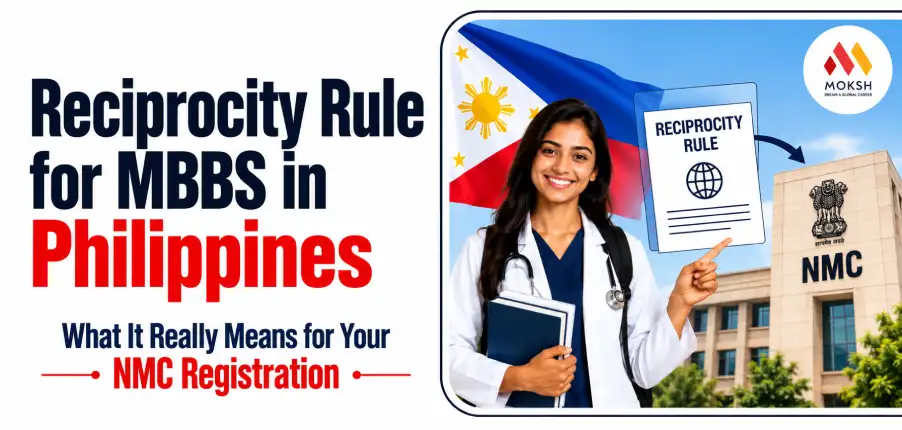
The reciprocity rule is a Philippine law. It decides who can sit the local licensing exam in the Philippines. It has nothing to do with whether your MD degree counts in India. As of the Embassy of India's advisory dated 17 June 2026, this reciprocity status is still "awaited." But your path to NMC recognition and the FMGE or NExT exam runs on a separate track. That track is already confirmed.
On 8 May 2025, CHED issued a letter, while on 11 March 2026, a Philippine House Resolution was passed. Both report that the Philippine MD degree meets the FMGL Regulations of India. Students often mix up these two issues. This article separates them clearly, using only the Embassy's own advisory as the source.
What Is the Reciprocity Rule?
The reciprocity rule says a foreign national can only sit the Philippine Physician Licensure Examination (PLE) if their home country lets Filipino doctors practice there under the same terms. It is a condition set by Philippine law, not Indian law. This rule decides one thing only: who gets a local Philippine practice license. It does not touch your MD degree, your NMC status, or your ability to work in India.
Here is the simple breakdown:
| Term | What It Means |
|---|---|
| Reciprocity rule | A Philippine legal condition for foreigners to sit the PLE |
| PLE | The Philippine Physician Licensure Examination, needed for a local license |
| Applies to | Practicing medicine inside the Philippines as a foreign graduate |
| Does not apply to | NMC recognition, FMGE/NExT eligibility, or practicing in India |
Current Status: What the Embassy Says Right Now
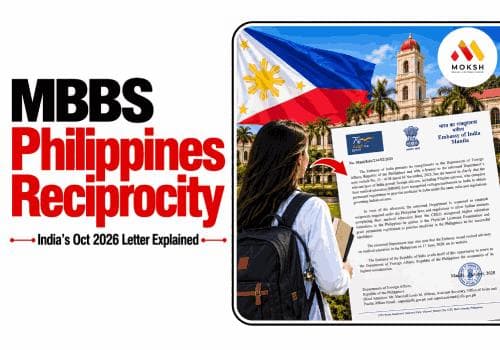
As of the Embassy of India's advisory dated 17 June 2026, reciprocity between India and the Philippines has not been finalized. The advisory states that guidance from Indian authorities on this specific point is still awaited.
One detail matters here. According to CHED, foreign graduates heading to the USA, UK, Canada, Australia, or Switzerland do not need to clear the PLE at all. They just need to pass whatever exams those countries require. This confirms something important: the PLE and its reciprocity condition are a Philippines-only issue. They were never meant to be a global gatekeeper for your degree's value.
The Core Distinction: Reciprocity vs. NMC Recognition
The reciprocity rule and NMC recognition of your MD degree are two separate approval processes. They run on different laws, different regulators and different timelines. One is paused. The other is already settled.
| Reciprocity Rule (PLE) | NMC Recognition (FMGL Regulations) | |
|---|---|---|
| Governs | Local license to practice in the Philippines | Eligibility for FMGE/NExT and practice in India |
| Regulated by | Philippine PRC, under Philippine law | National Medical Commission, India |
| Current status | Awaited (per Embassy, 17 June 2026) | Confirmed compliant (CHED letter, 8 May 2025; House Resolution No. 73, 11 March 2026) |
| Required for Indian students returning to India? | No | Yes |
| Blocks your India career path? | No | No, since it is already met |
What the Embassy Advisory Confirms About MD Degrees
The Philippine MD degree meets India's FMGL Regulations 2021. This comes straight from a letter CHED sent to the Indian Embassy on 8 May 2025. The letter lists five specific points and each one lines up with what NMC requires from a foreign medical degree.
-
A 54-month Doctor of Medicine program, not counting the earlier pre-medical BS course
-
Mandatory subjects that match Schedule-I of NMC's notification dated 18 November 2021
-
Instruction that runs entirely in English
-
A required 12-month internship, done at the same institution or its attached hospital
-
A Certificate of Registrability, confirming the graduate is fit for Philippine practice
There is a second confirmation, too. On 11 March 2026, the Philippine House of Representatives adopted House Resolution No. 73. It officially validated that MD from CHED recognized institutes is valid under the rules of NMC for Indian students studying abroad. Two separate bodies, on two separate dates, arrived at the same conclusion.
Does the Reciprocity Rule Affect Your FMGE/NExT Eligibility?
No. FMGE/NExT eligibility depends on NMC's FMGL Regulations, not on the reciprocity status between India and the Philippines.
Here is how NMC actually checks your degree. It looks at your course structure: how long your MD ran, whether you covered Schedule-I subjects, whether you completed your internship and whether your school appears in the World Directory of Medical Schools (WDOMS). It does not check whether you hold a Philippine local license. That license and your Indian eligibility are unrelated boxes on unrelated forms.
One more point worth knowing: Section 34 of the NMC Act covers temporary registration for foreign nationals practicing inside India. This is a different rule entirely and it has no bearing on Indian citizens returning home after a Philippine MD.
University of Northern Philippines: Compliance Checklist
University of Northern Philippines (UNP) meets every FMGL requirement named in the Embassy advisory. Here is how each rule maps to what the university actually delivers.
| FMGL/NMC Requirement | UNP Compliance |
|---|---|
| 54-month MD programme | Yes |
| Schedule-I subjects | Yes |
| English medium instruction | Yes |
| 12-month internship | Yes, at affiliated teaching hospitals |
| WDOMS listing | Yes |
| CHED recognition | Yes (state university, founded 1906; College of Medicine since 1996) |
| NEET-UG qualification | Required for all Indian applicants |
| Donation or capitation fee | None charged; it is a state-funded public university |
What This Means If You Missed Your NEET Cutoff
Missing a government college cutoff does not mean your only local option is an expensive private seat. If your goal is to practice medicine in India, the pending reciprocity rule gives you no real reason to rule out the Philippines or UNP specifically.
Your actual checklist is short. Qualify NEET. That part is fixed and cannot be skipped. Then complete your MD at an NMC-compliant college like UNP. After that, sit for FMGE or NExT back in India. The reciprocity rule never enters this sequence. It sits off to the side, governing a license you were never planning to use.
In Conclusion
The reciprocity rule blocks one specific thing: a foreign national's path to a local Philippine practice license. It does not block your MD degree's validity, your NMC eligibility, or your path back to practicing in India. University of Northern Philippines already meets every FMGL requirement the Embassy has confirmed and it does so without charging a donation. For a NEET-qualified student who missed the government cutoff, that combination is worth a closer look.
.png&w=640&q=75)