

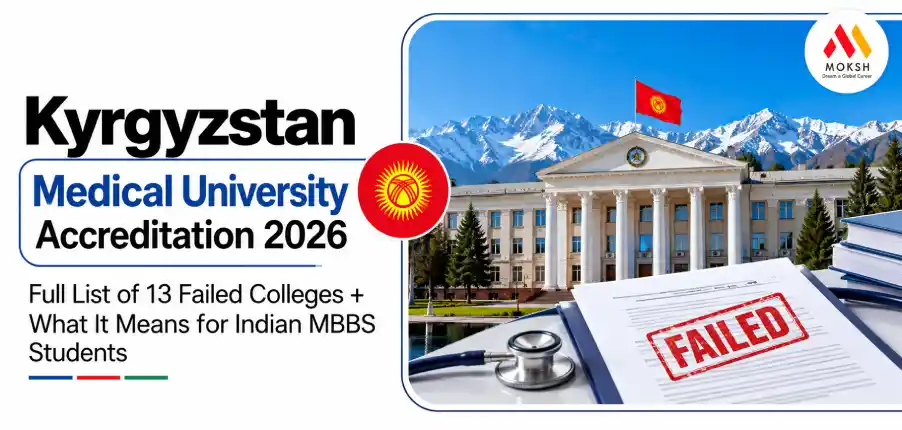
Thirteen medical universities in Kyrgyzstan failed the country's 2026 state accreditation review. The Kyrgyzstan Ministry of Health published these results in June 2026, after a reform tied to a presidential decree on medical education. The Indian Embassy in Bishkek confirmed the full list in an official advisory dated July 13, 2026. More than 2,000 Indian MBBS students are affected, according to the All India Medical Students Association (AIMSA). The bigger problem is not the failed accreditation itself. It is what happens next. The Kyrgyz government is transferring these students to accredited colleges. But NMC FMGE rules from 2021 do not clearly allow transfers between institutions. That gap is still unresolved as of late September 2026 and it is the real reason students and parents are worried.
What Happened: Timeline of the Accreditation Reform
This crisis did not appear overnight. It built up over a year of policy changes.
- August 28, 2025 - President Sadyr Japarov signed a decree on medical education in Kyrgyzstan which created a state monopoly.
- April 16, 2026 - The Cabinet of Ministers approved the accreditation standards universities had to meet.
- April 27, 2026 - Universities had to submit self-assessment reports by this date.
- June 1, 2026 - This was the hard deadline for accreditation. The government refused to extend it.
- Early June 2026 - The Ministry of Health released the results. Only 24 of Kyrgyzstan's 34 medical institutions went through the review.
- July 13, 2026 - The Indian Embassy in Bishkek issued a formal advisory naming every failed and provisional university.
- September 2026 - AIMSA wrote to India's Minister of External Affairs, Dr. S. Jaishankar, asking for urgent help.
The Results: Accreditation Outcome Table
The numbers below come from the Kyrgyzstan Ministry of Health and match the Indian Embassy's advisory.
| Accreditation Outcome | Number of Institutions | What It Means |
|---|---|---|
| 6-Year Accreditation | 4 | Full recognition. This is the most stable status a university can hold. |
| 1-Year Provisional | 7 | The university must reapply soon. Long-term status is uncertain. |
| Not Accredited (Failed) | 13 | The university cannot enroll new students. Its license faces suspension. |
| Treaty-Exempt / Not Reviewed | 10 | These institutions sat outside the 2026 review due to legacy or treaty status. |
Full List: 13 Medical Universities That Failed Accreditation
A failed university cannot admit new international students. It also cannot issue state-recognized diplomas and its operating license is at risk of suspension. Here is the complete, embassy-verified list of the 13 Kyrgyzstan medical universities that did not pass the 2026 state accreditation review:
- Avicenna International Medical University
- ADAM University
- Altamimi International University
- Ala-Too International University
- Bishkek International Medical Institute (BIMI)
- Central Asian International Medical University (CAIMU)
- Eurasian International University
- International Medical University (IMU)
- International University of Medicine and Science
- Kyrgyz Medical and Dental Institute
- Osh International Medical University (OIMU)
- Royal Metropolitan University (RMU)
- Salymbekov University
If your university appears on this list, do not panic yet. Read the section on what to do next before making any decision.
Universities on 1-Year Provisional Accreditation (Watch List)
These seven institutions passed, but only barely. Their provisional accreditation of 1-year means they face another review very soon and nobody can guarantee they will pass it.
- Kyrgyz National University (named after J. Balasagyn)
- Jalal-Abad State University (named after B. Osmonov)
- Kyrgyz-Uzbek International University (named after B. Sydykov)
- Issyk-Kul State University (named after K. Tynystanov)
- Jalal-Abad International University
- University of South Asia (USA), Tokmok
- International European University (IEU)
Treat these as higher-risk than a fully accredited university. A one-year pass today does not guarantee a pass next year.
The Real Crisis: NMC, FMGE and Student Transfers
This is where the story gets complicated and where most other articles stop too early.
What's happening to enrolled students: Kyrgyzstan launched a centralized transfer program. Students at the 13 failed universities are being moved to accredited institutions. The Kyrgyz government runs this process, not the students themselves.
The conflict: NMC FMGL 2021 Regulations do not allow the students to change medical institutions. If students do change, then they lose their eligibility for the FMGE or NExT screening exam. These rules were written for voluntary transfers, not government-ordered ones. Nobody built a clear exception for this exact situation.
Who's affected: AIMSA estimates that more than 2,000 Indian students face this uncertainty. Some reports put the number closer to 3,000.
Current status, as of late September 2026: AIMSA's Foreign Medical Students Wing wrote directly to Dr. Jaishankar, asking the Ministry of External Affairs to step in. The Indian Embassy in Bishkek has already emailed the NMC, requesting a one-time exemption for these students. As of this writing, the NMC has not responded.
What this means for you, practically: Do not assume your transferred degree will automatically qualify for FMGE. The rule gap is real and it is still open. Watch for a written statement from the NMC or the Indian Embassy before making long-term plans.
What Should You Do Now
Your next step depends on which group you belong to.
If you're currently enrolled at one of the 13 failed universities
- Confirm your transfer status directly with your university or the Kyrgyz Ministry of Health. Do not take an agent's word for it.
- Get every transfer document in writing. It should list the new institution's name, its accreditation status and the exact transfer date.
- Do not arrange your own transfer outside the government's centralized process. Doing so could hurt your FMGE eligibility even further.
- Follow updates from the NMC and the Embassy of India in Bishkek directly. Skip the consultants and agents for this specific issue.
If you're a new aspirant applying for 2026-27 admission
- Check any university's name against the two lists above before you pay a single rupee.
- Ask for the actual accreditation certificate, including its issue date. A brochure or a verbal promise is not proof.
- Be wary of any agent pushing same-day payment. That pressure is a red flag in a year like this one.
- Favor universities with 6-year accreditation or treaty-exempt status, especially those with independent international accreditation from bodies like EdNet or WFME-linked agencies.
Sources
- Indian Embassy, Bishkek - Advisory dated July 13, 2026
- Indian Embassy, Bishkek - Advisory dated April 29, 2026
- Kyrgyzstan Ministry of Health - Accreditation results, June 2026
- AIMSA Foreign Medical Students Wing - Letter to Minister of External Affairs, September 2026