


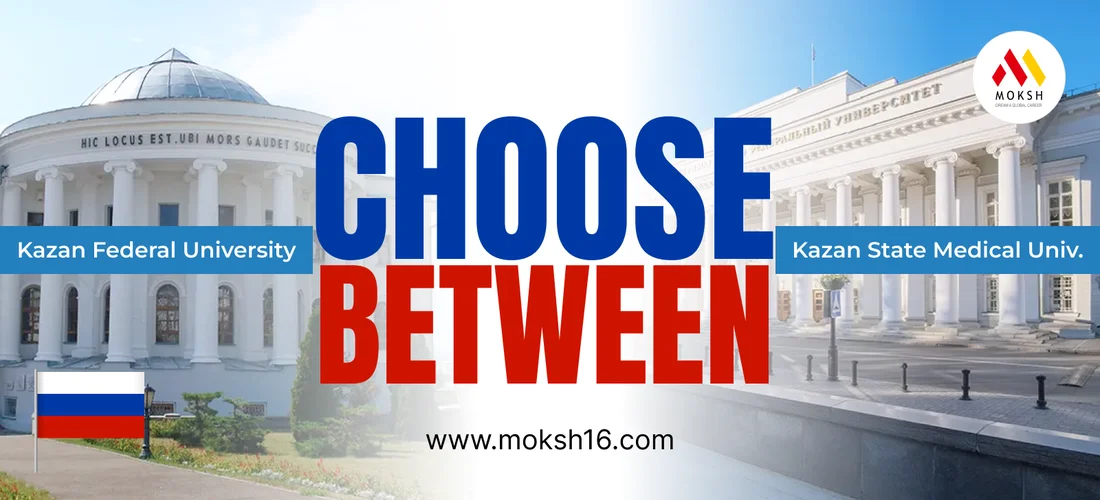
Congratulations on deciding to pursue higher education in the vibrant city of Kazan, Russia! Now comes the exciting but crucial step of choosing the university that best suits your academic aspirations.
Kazan boasts two exceptional institutions: Kazan Federal University (KFU) and Kazan State Medical University (KSMU). Each offers unique strengths and programs. This blog will give the key differences to help you make an informed decision.

Reputation and Accreditation
Kazan State Medical University is renowned globally, particularly in medical education. Accredited by the Russian Ministry of Health a beacon of excellence in producing highly qualified healthcare professionals. Similarly, Kazan Federal University, one of Russia's oldest and most prestigious universities, boasts a stellar reputation across various disciplines, including medicine.
Program Offerings
When it comes to program offerings, KSMU shines with its comprehensive array of medical programs. From general medicine and dentistry to pharmacy and nursing, KSMU provides a diverse range of options tailored to cater to different medical career paths. On the other hand, KFU takes a broader approach, offering not only medical programs but also a spectrum of disciplines spanning natural sciences, humanities, and engineering.
Faculty and Research Opportunities
Kazan State Medical University prides itself on its roster of highly qualified faculty members, each equipped with extensive experience in their respective fields. This expertise translates into ample research opportunities for students, with ongoing projects and collaborations enriching the learning experience. Similarly, Kazan Federal University attracts distinguished professors and researchers worldwide, fostering a dynamic academic environment conducive to research and innovation.
Language of Instruction
At KSMU, most programs are delivered in Russian, with select courses offered in English to accommodate international students. Conversely, KFU caters to a diverse student body by offering programs in both Russian and English, ensuring accessibility for students from various linguistic backgrounds.

Location and Campus Life
Nestled in the vibrant city of Kazan, both universities offer a rich tapestry of cultural experiences and recreational opportunities. Kazan State Medical University campus provides a dynamic hub for student life, while KFU's campus embodies the city's rich cultural heritage, offering a vibrant community for students to thrive in.
Tuition Fees and Scholarships
Tuition fees at both universities are competitive scholarships and financial aid are accessible for eligible students. Both institutions are committed to ensuring that quality education remains accessible to students from diverse socioeconomic backgrounds.
Have a look at below table for comparison of cost:
| University | Program | Tuition Fees (approx. per Year) | Cost in RUB |
|---|---|---|---|
| Kazan State Medical Univ. | MBBS | Rs. 4,59,000 | RUB 4,59,000 |
| Kazan Federal University | MBBS | Rs. 3,85,000 | RUB 478,000 |
NOTE: Tuition fees can change year to year. Be sure to get in touch with right study abroad consultant for the most up-to-date information.
Student Support Services
KSMU and KFU prioritize the well-being and success of their students, offering comprehensive support services ranging from academic advising to their stay at the university. Both university hostels have all the facilities and special services given to Indian students; Indian mess is given at Kazan State Medical University and Kazan Federal University.
Conclusion
Choosing between Kazan State Medical University and Kazan Federal University is a pivotal decision that requires careful consideration of various factors. Each part plays an important role in shaping your academic journey, from program offerings and research opportunities to campus life and the language of instruction.
By weighing the pros and cons of each university against your personal aspirations and career goals, you can confidently embark on your medical education journey, knowing that you've chosen the path that aligns with your vision for the future.


.png&w=640&q=75)