

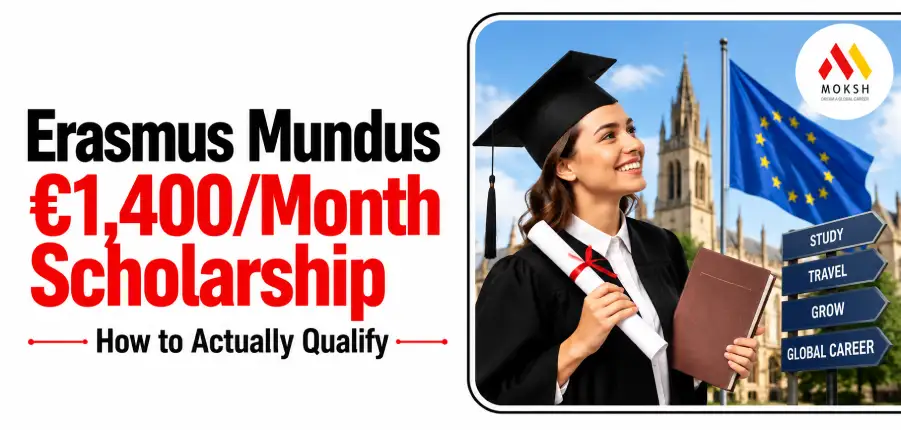
The Erasmus Mundus Joint Master's (EMJM) scholarship pays €1,400 a month for total 24 months. That adds up to €33,600, plus a full tuition waiver and health insurance. The money funds a master's degree split across two or three European universities. To qualify, you need a bachelor's degree, or proof that you will finish one before September 2027. You also need to meet the academic and language bar set by your chosen program and you need to score well on four things: your past grades, your CV, your motivation letter and your recommendation letters. The competition is real. Indian applicants had a 20.3% success rate last cycle. The EU funds close to 3,000 scholarships a year across more than 160 programs.
What the Scholarship Actually Pays
Before you plan an application, know what you are applying for. The numbers are fixed by the EU, but how they get paid out shifts from one consortium to the next.
| Component | Value |
|---|---|
| Monthly stipend | €1,400 (up to 24 months) |
| Total stipend value | Up to €33,600 |
| Tuition fees | Fully waived |
| Insurance | Fully covered |
| Travel and installation allowance | Included, amount varies by consortium |
| Payment model | Varies by program |
Eligibility for the 2027-28 Cycle
The baseline rules apply to almost every program, though some add their own layer on top.
Core eligibility:
- A completed bachelor's degree, or you are in your final year and will graduate beforehand the program starts in September 2027
- An equivalent qualification works too, if your country officially recognizes it as bachelor's level
- You have never received EMJM funding before
- You meet the specific program's GPA or academic threshold. This is often 60 to 70 percent or a 3.0-plus on a 4.0 scale, though competitive fields push this higher
- Proof of English proficiency, usually IELTS or TOEFL, unless the program states otherwise
- Some programs require your undergraduate degree to match the master's field. Others do not. Check each one.
The 12-month rule. This one gets missed often and it can change your entire application category. If you lived, worked, or studied in the EU, Norway, or Iceland for more than a year within the last five years, you get classed as a Programme Country student instead of a Partner Country student. That reclassification affects which quota you compete in and, on some programs, your funding odds. If you have spent real time in Europe recently, check this before you apply.
2027-28 Deadlines and Application Timeline
There is no single deadline for Erasmus Mundus. Each consortium sets its own, so you need to track this per program, not once for the whole scholarship.
| Milestone | Timing |
|---|---|
| New EMJM programs selected | 37 new consortia, spanning 33 countries |
| Catalogue update | Rolling, added directly to the official EMJM catalogue |
| Applications open | Autumn 2026 |
| Typical deadline window | October 2026 to January 2027, varies by program |
| Example confirmed deadlines | December 1, 2026; January 7, 2027; February 1, 2027 |
| Program start | September 2027 |
The Real Selection Criteria
Most guides stop at "submit a strong application." That tells you nothing. Several EMJM consortia publish their actual scoring rubric and it looks like this.
| Criterion | Max Points | What It Measures |
|---|---|---|
| Academic qualification | 60 | Your grades, degree relevance and the rigor of your institution |
| CV and relevant experience | 20 | Internships, research, leadership and work history |
| Motivation letter | 15 | How clearly your goals fit the program, not just enthusiasm |
| Recommendation letters | 5 | How credible and specific your referee's endorsement is |
Academic performance carries the most weight, at 60 percent of the score. But 40 points sit outside your transcript. A sharp CV and a specific, well-researched motivation letter can pull a borderline GPA across the line. This is the direct answer to the question every applicant with a 3.0 GPA asks: grades matter most, but they are not the whole story and the rubric proves it.
How to Actually Qualify: 5 Strategic Levers
- 1
Pick programs for fit, not prestige.
Apply because the curriculum and the consortium's research areas genuinely match your background. Selection committees read hundreds of letters a year. They can tell a student who wants this exact program from one who wants a famous university name attached to their degree.
- 2
Name the professors you want to work with.
Find two or three faculty members across the partner universities whose published research lines up with your interests. Read their recent papers. Reference their work directly in your motivation letter. This single move signals real intellectual intent and it feeds straight into that 15-point motivation score.
- 3
Check each program's scholarship track record.
The number of funded seats per program is public information, published on each consortium's website. Some programs fund a much higher share of their admitted students than others. Spread your three applications across a mix: one competitive, one moderate, one where your profile is a strong match with less competition.
- 4
Let your CV and letter cover for a weak GPA.
If your grades sit below a program's stated range, the other 40 points are where you fight back. Research projects, internships and a motivation letter built around specific evidence, not general enthusiasm, close that gap in ways a transcript alone cannot.
- 5
Choose referees who know your actual work.
A recommendation letter from a family friend, a distant employer, or an administrator with no direct knowledge of your output carries almost no weight. Ask a professor who supervised your thesis, or a manager who saw your daily work. Specificity beats seniority every time.
Required Documents Checklist
Every consortium asks for a version of the following. Confirm the exact list on your target program's page before you start.
- Certified bachelor's degree certificate or transcript, or proof of expected graduation
- CV, ideally in Europass format unless the program asks for something else
- Motivation letter, written fresh for each program, not recycled
- One or two recommendation letters
- English proficiency certificate, or documentation of a waiver if you qualify for one
- Passport or national ID copy
- Program-specific extras where required: research proposal, portfolio, or writing sample.
There is no central EMJM application portal. You submit documents directly through each consortium's own website, one program at a time.
.png&w=640&q=75)