


Indian students are moving to Europe because the US and Canada got harder to predict. GyanDhan loan data shows Europe took about 39% of Indian applicants in 2025, while the US share fell from 54% in 2023 to about 20%. Three countries lead the shift.
Germany wins on cost and size. Most public universities charge no tuition and about 70,000 Indian students enrolled in winter 2025/26. France offers low public fees and up to two years of post-study stay for Indian master's graduates, though fees are rising. Ireland teaches fully in English and allows up to 24 months of work after a master's. It also costs the most.
Pick Germany for engineering on a tight budget. Pick France for business or design. Pick Ireland if English-only study matters more than price.
Why are Indian students choosing Europe over the US and Canada?
Visa refusals and sudden rule changes pushed students toward countries with clear costs and clear rules for work after study.
A study plan rests on three things: a visa, a budget and a path to a job. The US and Canada made all three shaky. Families do not want to pay for a degree and then hope.
| Destination | What changed |
|---|---|
| US | Share of GyanDhan's Indian applicants fell from 54% (2023) to about 20% (fall 2025) |
| Canada | 74% of Indian study permit applications were denied in August 2025, up from 32% a year earlier |
| UK | Graduate Route shrinks from two years to 18 months for applications from 1 January 2027 |
| Europe | About 39% of GyanDhan's Indian applicants in 2025, up 143% |
GyanDhan's numbers come from education loan applicants, not from every student. They still show a sharp turn.
The India-EU free trade agreement, concluded on 27 January 2026, includes a framework for student entry and post-study work visa routes. It is a framework. It does not create new visas by itself. One consultancy, Europe Study Centre, reported 25% to 30% more enquiries after the deal. Treat that as one firm's signal.
Study in Europe also offers something simple: a price you can plan around. Public fees in Germany and France are low and published in advance. A family can build a rupee budget and trust it. That matters for any study abroad Plan B after a US visa refusal.
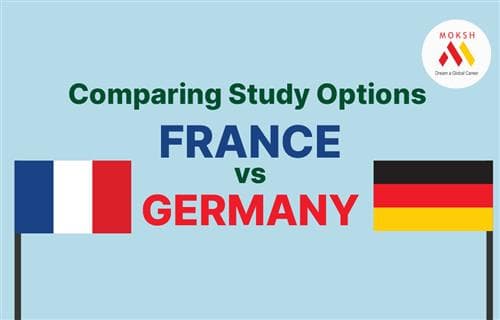
Germany vs France vs Ireland: which country wins for Indian students?
Germany wins on cost, France wins on post-study stay and low public fees and Ireland wins on English-only teaching.
| Factor | Germany | France | Ireland |
|---|---|---|---|
| Tuition (non-EU) | Mostly none; exceptions such as Baden-Württemberg (about €1,500 per semester) | About €2,900 (bachelor's), about €3,900 (master's); rising | Master's about €12,000 to €35,000 a year |
| Proof of funds | €11,904 blocked account | Confirm on Campus France | €10,000 living funds; tuition paid up front |
| Post-study stay | 18 months | Up to 24 months for Indian master's graduates | 12 months (Level 8); up to 24 months (Level 9+) |
| English-taught options | About 1,930 master's programmes | Growing | Fully English |
| Best for | STEM; lowest cost | Business; design | English-only study; tech |
| Main risk | Competition; private programme debt | Fee increases | Highest cost; Dublin housing |
Fees and rules change often. Check each official site before you pay anything.
Germany: lowest cost and the largest Indian community
Study in Germany costs the least for most Indian students and its Indian student numbers keep rising.
Indian enrolment rose 17.5% to 69,816 in winter 2025/26, making Indians Germany's largest international group. Most tuition-free universities are public. You still pay a small semester fee. Baden-Württemberg is the known exception and charges non-EU students about €1,500 per semester.
Three items come first:
- Blocked account (Sperrkonto): €11,904 for a year, released at about €992 a month.
- APS certificate: Indian applicants need it and it takes time, so start early.
- 18-month job-seeker visa: after your degree, you get 18 months to find work linked to your field.
Germany offered about 1,930 English-taught master's programmes in summer 2025, according to DAAD. Apply through the university or uni-assist. Good programmes draw many applicants, so apply to several.
Watch for one risk. Fast growth brought debt and immigration trouble for some students in private and hybrid programmes. Confirm that a university is state-recognized before you pay a single euro.
France: low public fees, a two-year stay, rising costs
Study in France gives Indian master's graduates up to 24 months to find work and its public fees stay far below US prices.
Public universities charged non-EU students €2,895 for a bachelor's and €3,941 for a master's in 2025-26. France announced higher fees from 2026/27. Private schools set their own prices, often between €6,000 and €18,000 a year.
Application
Indian students apply through Campus France and the Études en France platform.
Post-study permit
the APS (also called RECE) normally gives 12 months. An India-France arrangement adds 12 more for master's-level Indian students. Confirm the current rule with your prefecture, because bilateral terms can change.
Fields
The French Consul General in Kolkata said most Indian students study management.
Goal
France wants 30,000 Indian students by 2030.
Fee increases are the main risk here. Budget a buffer and ask each school for its exact tuition fees in writing.
Ireland: English-taught, a longer stay, the highest cost
Ireland teaches fully in English and lets master's graduates stay up to 24 months, but tuition runs higher than in Germany or France.
Non-EU master's tuition runs from about €12,000 up to €40,000 a year, depending on the field and living costs add roughly €12,000 to €18,000. New visa rules from 30 June 2025 require stricter financial proof, upfront tuition and biometrics. Visa applicants must also show access to at least €10,000 for living costs. Most taught master's programmes last one year, which trims living costs.
Stamp 1G, under the Third Level Graduate Programme, covers the stay after study:
- Level 8 (bachelor's): 12 months.
- Level 9 and above (master's, PhD): 24 months, granted in two 12-month blocks.
- Second block: you must show steps toward a graduate-level job.
An employer can then apply for an employment permit for you. The Critical Skills Employment Permit is the usual route. Dublin rent is the other pressure point, so compare Cork, Galway and Limerick too.
Which country should you choose?
Match the country to your budget, your subject and your comfort with language.
| If you... | Choose |
|---|---|
| Have a tight budget and want engineering or STEM | Germany |
| Want business, design or luxury and a longer stay | France |
| Need English-only study and can fund higher costs | Ireland |
Know who should skip each one:
- Skip Germany if you must start within weeks. The APS certificate, blocked account and visa all take time.
- Skip France if you need a fixed, low budget. Fees are rising.
- Skip Ireland if money is tight. It costs the most of the three.
Add up tuition, living costs and visa funds for the full degree before you decide. Do the math twice.
What should you do now for the next intake?
The Fall 2026 intake has closed for most programmes, so plan for the next one.
- Shortlist programmes at state-recognized universities.
- Germany: book your APS certificate and open a blocked account.
- France: build your Études en France profile on Campus France.
- Ireland: plan the tuition deposit and the €10,000 in living funds.
- Everywhere: ask your bank about an education loan early.
Check each university's deadline yourself. Dates differ by programme and by country and they change.