

The System Has Changed. Here Is What That Means for You.
India has one allopathic doctor for every 1,511 rural patients. The WHO says the ratio should be 1:1,000. That gap has existed for decades. The government now admits it cannot close that gap alone.
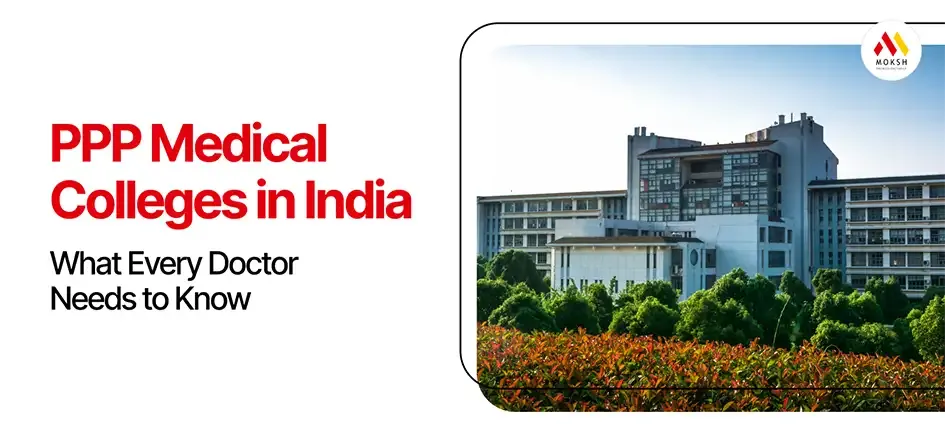
The answer it has chosen is the Public-Private Partnership model for medical colleges. The idea is straightforward: let private money build the college, use the government's existing hospitals for clinical training, and expand MBBS seats fast.
In 2026, the National Medical Commission took this further. It removed the rule that prevented for-profit companies from running medical colleges. That single decision changed everything.
If you are a doctor - faculty, resident, or practitioner - this shift affects your career, your students, and your patients. Here is everything you need to know.
How the PPP Model for Medical Colleges Actually Works
The PPP model for medical colleges in India follows what is called the Brownfield development model. Here is the basic deal structure:
- The government provides a functioning district hospital. It already has patients, beds, and clinical load.
- The private partner called the Concessionaire, builds the medical college next to it. They finance it, design it, and run it.
- The private partner also upgrades and maintains the district hospital as part of the agreement.
This is different from building a new private hospital from scratch. The clinical material is already there. That is the key advantage.
The government makes the deal commercially viable through Viability Gap Funding (VGF). Without this, no private company would build a medical college in a remote or tribal district.
| Mechanism | Detail |
|---|---|
| VGF Capital Support | Up to 60% of Total Project Cost (30% Central + 30% State) |
| VGF Operational Support | Up to 25% of O&M costs for the first 5 years |
| Land Lease | Concessional rate, approximately 8% of circle rate |
| Concession Period | 33+33 years, extendable to 99 years |
| Minimum MBBS Intake | 100-150 seats per NMC norms |
The Model Concession Agreement (MCA) governs every term. These agreements run for 33 to 60 years. In some cases, up to 99 years. That is not a short experiment. That is a generational transfer of public infrastructure to private management.
NITI Aayog's PPP Vertical designed this framework. The Department of Economic Affairs revamped the Viability Gap Funding scheme to make social sector projects - including medical colleges - eligible for this level of support.
The 2026 NMC For-Profit Rule: What Changed and Why It Matters
Can for-profit companies run medical colleges in India? As of 2026, yes.
Before 2026, only non-profit entities could establish medical colleges. Section 8 companies, trusts, and registered societies. The logic was simple: medicine should not be driven by profit.
In late 2025 and early 2026, the NMC board deleted that restriction. For-profit corporate entities can now enter medical education in India directly. NMC Chairman Dr. Abhijat Chandrakant Sheth said the change would bring efficient resource use and align Indian medical education with international standards.
The Bombay High Court disagreed - at least in part. In January 2026, it upheld Regulation 6g of 2023 in a specific case. The court ruled that medical colleges must not be profit-driven. It warned that corporate entry could create monopolies and inflate fees.
So the situation right now is this: the NMC for-profit amendment says corporate entities can enter. A sitting High Court says profit motive is legally problematic. This conflict is not resolved.
What this means for doctors:
- Large healthcare corporations can now invest directly in medical education
- Fee structures at PPP medical colleges are likely to rise as profit motives enter
- Faculty employment will increasingly follow private-sector accountability norms
- The IMA and FAIMA have both flagged commercialisation risk - this debate is active inside the fraternity
Which States Have PPP Medical Colleges in India - and What Is Actually Happening
This is not a uniform national rollout. Every state is doing something different. Some are building fast. Some are fighting in court. One rejected the model entirely.
| State | PPP Projects | Model Type | Status (2026) | Key Note for Doctors |
|---|---|---|---|---|
| Uttar Pradesh | 16 districts | VGF Brownfield | Tenders invited; 1,200 faculty posts opening in 2026 | MBBS seats grew from 4,540 in 2017 to 12,800 in 2025 |
| Madhya Pradesh | 4 districts | Tribal-area focus | Bhumi Pujan done in Dhar and Betul | District hospitals stay under state control |
| Andhra Pradesh | 10 colleges | Full private management | Pre-bid meetings held; SC dismissed PIL | G.O. 590 is legally contested - situation is fluid |
| Gujarat | Multiple (GMERS) | Semi-autonomous state body | Operational; national template | Higher pay for faculty who opt out of private practice |
| Karnataka | 0 | Pure government | CM announced all-government route | Explicitly rejected PPP over fee and access concerns |
Uttar Pradesh: The Biggest Push
UP is targeting a PPP medical college in every one of its 75 districts. It has allocated Rs. 14,997 crore for medical education. Districts like Baghpat, Mainpuri, Hathras, Kasganj, Mahoba, and Hamirpur are being operationalised right now. In 2026 alone, UP plans to recruit 1,200 faculty members.
Madhya Pradesh: The Tribal Equity Approach
MP launched what it calls the first PPP-model medical colleges in tribal-dominated districts - Dhar and Betul. The private partner builds the academic complex. The state keeps administrative control of the district hospital. This is a meaningful distinction. Public services to tribal populations are not handed over.
Andhra Pradesh: Political and Legal Heat
AP wants 10 PPP medical colleges in two years. G.O. 590 empowers this push. Medical groups and opposition parties have protested it. The Supreme Court dismissed a PIL challenging it. The state is moving forward. But for any doctor considering a faculty role in AP, the legal uncertainty around this model is real and ongoing.
Gujarat: The Model That Works
The GMERS model - Gujarat Medical Education and Research Society - is the closest thing India has to a proven template. Colleges are attached to upgraded district hospitals. The state body manages them. Faculty salaries are competitive, especially for those who choose non-practice arrangements.
Karnataka: The Rejection
Karnataka's Chief Minister announced the state will build only government medical colleges in every district. The explicit reason: concerns about fees and public access. This is the only major state that has formally said no to the PPP route.
PPP Medical College Faculty Salary in India: The Real Numbers
What is the salary of faculty in PPP medical colleges in India?
It depends on whether the post is permanent government cadre or contractual. Most PPP medical college faculty positions are contractual. Here is the comparison:
| Position | 7th CPC Basic Pay | Consolidated Contractual (Min) | Consolidated Contractual (Max) |
|---|---|---|---|
| Professor | Rs.1,59,100 (Level 14A) | Rs.1,88,000 | Rs.2,98,000 |
| Associate Professor | Rs.1,31,400 (Level 13A-1) | Rs.1,42,000 | Rs.2,60,000 |
| Assistant Professor | Rs.67,700-1,01,500 (Level 11/12) | Rs.89,400 | Rs.1,50,000 |
| Tutor / Demonstrator | Rs.56,100 (Level 10) | Rs.55,000 | Rs.70,000 |
The headline numbers look better on the contractual side. But the full picture is different.
What the salary table does not show:
- No pension, no dearness allowance, no HRA in most contractual appointments
- Tenure is typically 11 to 12 months or 2 years - renewal is not automatic
- Gujarat's GMERS offers significantly higher pay - up to Rs. 2,98,000 per month for a Professor - but only if the doctor opts out of all private practice
- Faculty must meet NMC Minimum Standard Requirements (MSR) and Teachers Eligibility Qualifications (TEQ) regardless of college type
- In states like AP, live litigation adds risk to any long-term commitment
Is a PPP Medical College Better Than a Private College for Clinical Training?
For clinical exposure, Brownfield PPP colleges attached to busy district hospitals are generally better than new Greenfield private colleges. Here is why.
A new private Greenfield hospital often takes years to build adequate patient footfall. A district hospital already has it. High case volume, high variety, and regional disease patterns that Tier-1 urban teaching hospitals do not see.
For residents and interns, this means real clinical load from day one. It also means training in the conditions where most of India actually gets sick.
The risk is administrative friction. The private college management and the state-run hospital may not always coordinate well. This can affect resource allocation and faculty accountability.
Before choosing a PPP college, ask these questions:
- Is the attached district hospital a genuinely high-footfall institution, or a low-volume facility?
- Does the state keep administrative control of the hospital (like MP), or is it handed to the private partner?
- What is the Category A versus Category B seat split, and what do both actually cost?
- Has the college received its NMC Letter of Permission and completed its first inspection cycle?
The Fee Problem and What It Does to the Medical Profession
Government medical college fees run between Rs. 6,000 and Rs. 50,000 per year. PPP medical college MBBS fees can run from Rs. 5 lakh to Rs. 20 lakh per year.
That gap has a consequence that goes beyond individual affordability.
When a student spends Rs. 80 lakh to Rs. 1 crore completing an MBBS, they need to earn that back. That means urban practice. High-billing specialties. It does not mean rural postings or public health work.
The PPP model is meant to fix India's doctor shortage. But if the fee structure it creates drives graduates away from underserved areas, it makes the problem worse - not better.
The reservation gap is also real. In many PPP model medical colleges, Category A seats carry government merit admission. But the fees on those "subsidised" seats are still far above traditional government medical college rates. This weakens the practical benefit of reservation for lower-income students.
What Doctors and Medical Associations Are Saying
The fraternity's reaction is not uniformly opposed. But the concerns are specific and serious.
IMA and FAIMA have both raised alarms about the commercialisation of clinical institutions. Former IAS officer P.V. Ramesh publicly said the AP PPP medical college push violates the constitutional right to life by transferring state health responsibility to private hands. Punjab doctors formally opposed their state government's PPP plans. On forums like r/indianmedschool, the ground-level concerns focus on faculty autonomy, fee exploitation, and corruption risk in poorly regulated private institutions.
The core fear is structural: concession agreements of 60 to 99 years mean the district hospital in your area may be under private management for the rest of your career.
NExT Exam: Does It Matter Which College You Graduate From?
Will a PPP medical college degree carry the same weight as a government medical college degree?
Under the National Exit Test (NExT), yes - in terms of licensure. Every MBBS graduate, regardless of institution, will sit the same NExT exam. It functions as both the common licentiate and the PG entrance test. The NMC's stated goal is a uniform competence benchmark across all college types. The quality floor is set by NExT, not by the college's ownership structure or brand.
What You Should Do With This Information
If you are a faculty aspirant:
- Compare consolidated contractual pay against the 7th CPC equivalent including all allowances - the gap is smaller than it looks
- Verify NMC Letter of Permission status and whether the first inspection cycle is complete
- For AP-based colleges, track G.O. 590 litigation before signing any long-term contract
If you are a student or resident:
- Choose a Brownfield PPP college attached to a high-footfall district hospital over a new Greenfield private institution
- Clarify Category A and B fees, annual escalation clauses, and bank guarantee requirements before admission
- Do not join a college in its first year of operation before NMC inspection is complete
If you are a practicing clinician:
- The hospitals in your district may operate under private management for the next 60 to 99 years
- Engage with your local IMA chapter now on accountability mechanisms in the Model Concession Agreement
- The NMC for-profit rule 2026 is the beginning of corporate entry into your professional ecosystem - not the end