



Overview
The Govt. of India has restructured the entire medical education system in India, which was very essential to bringing uniformity. So, as a part of this revamping, the NEET-UG Exam conducted by the NTA (National Testing Agency) replaced the former AIPMT exam in 2017. It took almost 5 years of hearings of multiple petitions by the Supreme Court to eventually scrap the AIPMT exam. Currently, aspirants get seats in medical colleges for MBBS and dental on the basis of their rank in the NEET-UG exam.
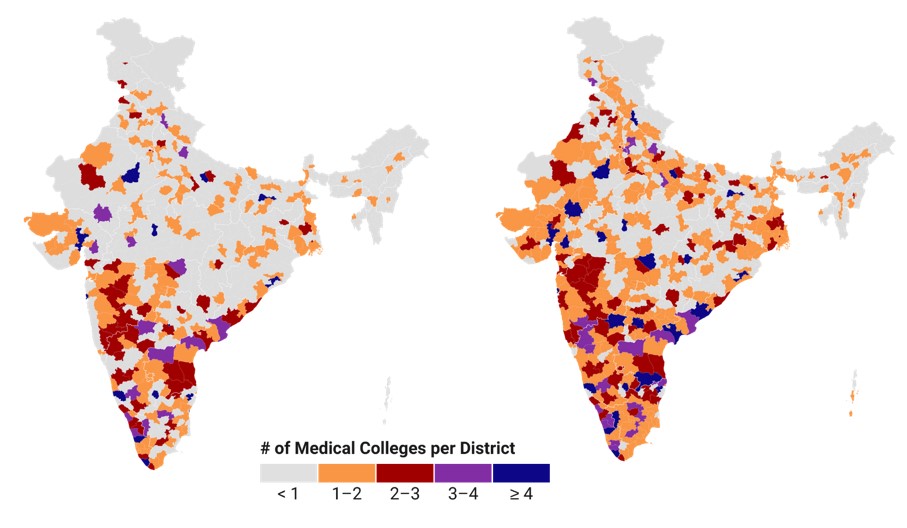
Change in Medical Colleges Footprint from 2014 to 2025
Quick Summary
| Total Medical Colleges MBBS Seats | 818 ( 1,28,875) |
| Duration fo MBBS Course | 4.5 + 1 Yr of Internship |
| Name of Entrance Exam | NEET UG |
| Total Subjects in MBBS | 19 |
| Examination Body | NTA |
| All India Counselling Body | MCC |
| State Counselling Body | DME or Medical Univ of Respective State |
| Gov Med Colleges Seats | 455 (63,682) |
| Pvt Med College Seats | 363 (65,193) |
| All India Quota Seats | 21,504 |
| State Quota Seats | 95,418 |
| Govt Seat Fee | 0.5 -1 Lac / Yr |
| Mngmt Seat Fee | 10 - 30 Lacs / Yr |
| NRI Seat Fee | 35 - 45 Lacs / Yr |
| Students Appeared NEET-UG 2025 | 22.09 Lacs |
| Chance for Govt College Seat | 2.88% |
MBBS in India - Important Links
Medical Colleges and MBBS Seats Availability
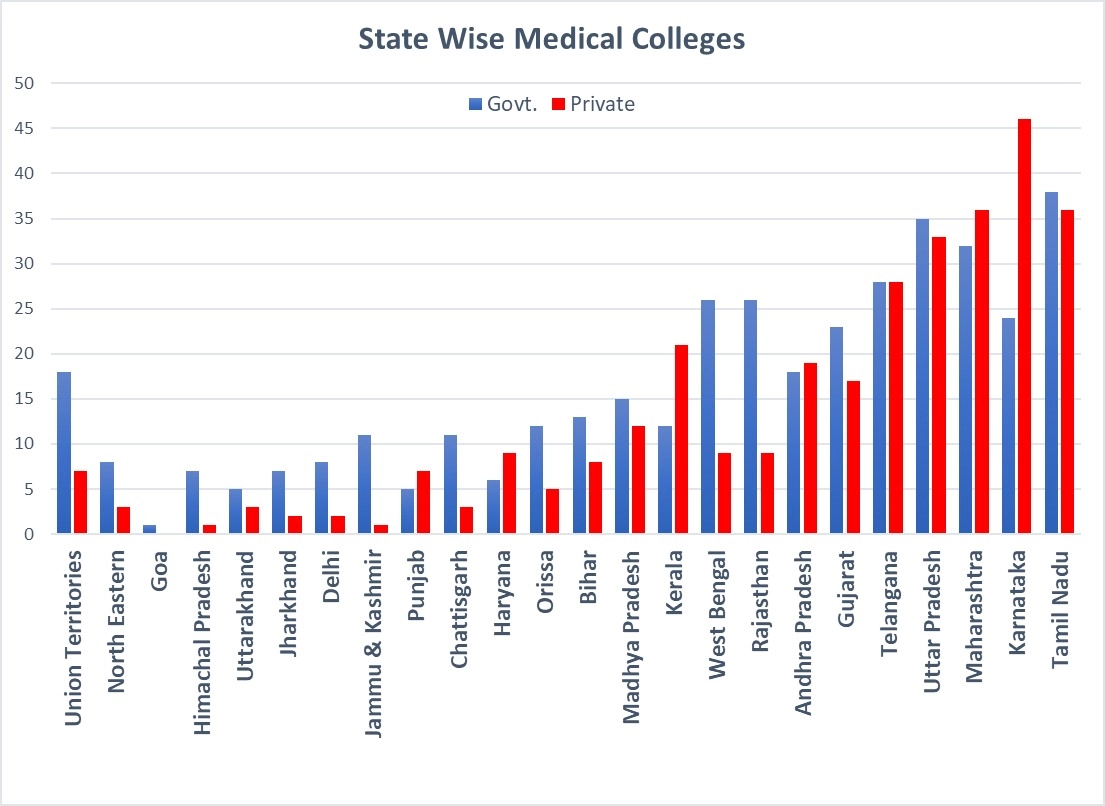
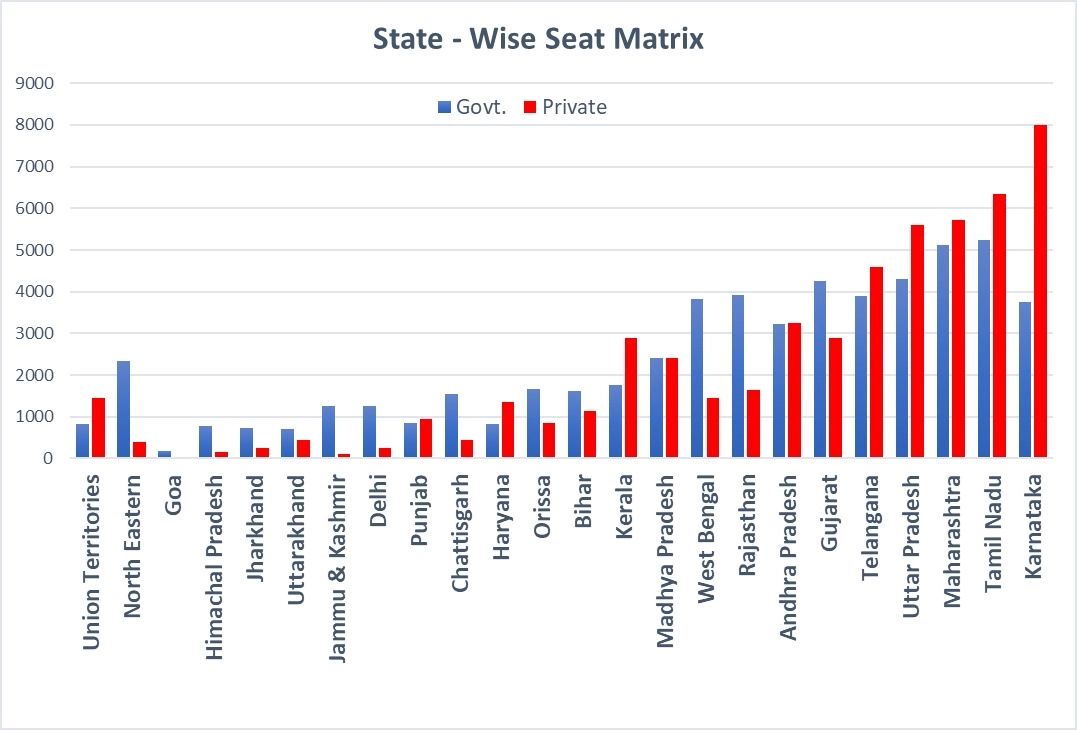
Currently, there are more than 818 Indian Medical Colleges in India. Among these, 455 are Govt. medical colleges, and the remaining 363 are Pvt Med colleges. In these colleges, total seats for Academic Year 2025-26 are more than 1.28 Lacs if we further bifurcate, government medical colleges hold 63,682 seats, and the remaining 65,193 seats are in Pvt Medical colleges. In the last 10 years, 327 Medical Colleges in India have been established, which account for nearly 50% of the total number of Medical Colleges. Karnataka has the highest count of MBBS seats among all Indian states, with 12,195 MBBS seats, followed by Tamil Nadu (11,950) and Maharashtra (11,845) and so on. You can refer to the table given below for detailed information
If we analyze the distribution of MBBS seats in India, we find that the southern part of India has the maximum number of seats, followed by the west, north, and East in that order. Due to the lower availability of seats and the higher number of applicants in UP and Bihar, the cutoff always goes on the higher side in comparison to Kerala and Tamil Nadu. For further clarity, here is a graphic representation of the number of MBBS Seats in each Indian state
| State Name | Total Colleges | MBBS Seats | Govt Colleges | MBBS Seats | Pvt Colleges | MBBS Seats |
|---|---|---|---|---|---|---|
| Andaman Nicobar Islands | 1 | 114 | 1 | 114 | 0 | 0 |
| Andhra Pradesh | 38 | 7215 | 19 | 3415 | 19 | 3800 |
| Arunachal Pradesh | 1 | 100 | 1 | 100 | 0 | 0 |
| Assam | 14 | 1975 | 14 | 1975 | 0 | 0 |
| Bihar | 22 | 3545 | 13 | 1645 | 9 | 1900 |
| Chandigarh | 1 | 150 | 1 | 150 | 0 | 0 |
| Chhattisgarh | 16 | 2455 | 11 | 1555 | 5 | 900 |
| Dadra Nagar Haveli | 1 | 177 | 1 | 177 | 0 | 0 |
| Delhi | 10 | 1396 | 9 | 1296 | 1 | 100 |
| Goa | 1 | 200 | 1 | 200 | 0 | 0 |
| Gujarat | 41 | 7525 | 23 | 4325 | 18 | 3200 |
| Haryana | 15 | 2710 | 6 | 1060 | 9 | 1650 |
| Himachal Pradesh | 8 | 970 | 7 | 820 | 1 | 150 |
| Jammu Kashmir | 12 | 1725 | 11 | 1525 | 1 | 200 |
| Jharkhand | 9 | 1255 | 7 | 855 | 2 | 400 |
| Karnataka | 73 | 13954 | 24 | 4249 | 49 | 9695 |
| Kerala | 34 | 5404 | 12 | 1855 | 22 | 3549 |
| Madhya Pradesh | 31 | 5725 | 18 | 3025 | 13 | 2700 |
| Maharashtra | 80 | 12824 | 42 | 6075 | 38 | 6749 |
| Manipur | 4 | 525 | 3 | 375 | 1 | 150 |
| Meghalaya | 2 | 200 | 1 | 100 | 1 | 100 |
| Mizoram | 1 | 100 | 1 | 100 | 0 | 0 |
| Nagaland | 1 | 100 | 1 | 100 | 0 | 0 |
| Odisha | 18 | 3025 | 13 | 1925 | 5 | 1100 |
| Punjab | 13 | 1899 | 5 | 999 | 8 | 900 |
| Rajasthan | 43 | 7330 | 31 | 4630 | 12 | 2700 |
| Sikkim | 1 | 150 | 0 | 0 | 1 | 150 |
| Tamil Nadu | 77 | 13050 | 39 | 5250 | 38 | 7800 |
| Telangana | 65 | 9540 | 36 | 4390 | 29 | 5150 |
| Tripura | 3 | 400 | 1 | 150 | 2 | 250 |
| UT of Puducherry | 9 | 1873 | 2 | 423 | 7 | 1450 |
| Uttar Pradesh | 86 | 13425 | 49 | 5925 | 37 | 7500 |
| Uttarakhand | 10 | 1450 | 6 | 750 | 4 | 700 |
| West Bengal | 37 | 6399 | 26 | 4149 | 11 | 2250 |
MBBS Seats Trends in last 5 Years
49% of government medical colleges (192 out of 389) and 42% Private Medical colleges (135 out of 317) were established in the last 10 years. This number is around 41% of the total medical colleges in India. In last 5 Years total 24 Thousand Seats added which is 22% of Total Seats whereas almost 5.5 Lacs more aspirants took NEET which is more than 42% ! Because of gap in number of aspirants and Seats availability it is a distant dream to become Doctor from a Govt Medical college in India.
As only 63,682 students get Govt seats in India against 22.09 Lacs appeared in NEET Exam 2025 , Success Ratio is only 2.88%. If we add 65,193 Private Seats with a budget of 70 Lacs- 1.5Cr, it still becomes less than 5%, which is not affordable for a Middle Class Family. Those who could not secure a Govt Seat and do not have a budget of 70 Lacs, they still can become a doctor from a Govt/ Public University from Abroad. These programs are English taught, within the budget of 20-30 Lacs and approved by NMC and other Medical Bodies across the Global like ECFMG/WHO. And, surprisingly 20,000+ students opt for MBBS through this route every year, which is almost one-third of the Students getting admission in Govt Medical Colleges in India.
| YEAR | MBBS Colleges | MBBS Seats | NEET Applicants (in Lacs) |
Chances of Govt Seat |
Overall Chances (Govt.+Pvt) |
||||
|---|---|---|---|---|---|---|---|---|---|
| Govt | Pvt | Total | Govt | Pvt | Total | ||||
| 2017 | 218 | 232 | 450 | 35870 | 34290 | 70160 | 11.4 | 3.14% | 6.16% |
| 2018 | 227 | 237 | 464 | 37140 | 35040 | 72180 | 13.3 | 2.79% | 5.44% |
| 2019 | 245 | 242 | 487 | 39385 | 35890 | 75275 | 15.2 | 2.59% | 4.95% |
| 2020 | 279 | 254 | 533 | 42735 | 37640 | 80375 | 16.0 | 2.67% | 5.03% |
| 2021 | 285 | 269 | 554 | 43335 | 39840 | 83175 | 16.1 | 2.69% | 5.16% |
| 2022 | 355 | 293 | 648 | 45125 | 45990 | 91115 | 18.7 | 2.41% | 4.86% |
| 2023 | 367 | 296 | 679 | 54168 | 50165 | 104333 | 20.9 | 2.58% | 4.97% |
| 2024 | 435 | 343 | 778 | 60863 | 55615 | 116922 | 24.0 | 2.64% | 4.89% |
| 2025 | 455 | 363 | 818 | 63682 | 65193 | 128875 | 22.8 | 2.88% | 5.66% |

Private Medical Colleges in India Vs MBBS Abroad
There are numerous benefits to the MBBS Abroad over study at Private Medical College in India. You can refer to the below table to understand the values we fetch in MBBS Abroad on various critical parameters, that are crucial before deciding the right path
| Key Parameter | MBBS Abroad | Private Medical College |
|---|---|---|
| University Type | Public Private Both | Only Private |
| World Ranking | Available | Not Available |
| Recognition | WHO, WFME, ECFMG, US GMC,UK etc | NMC and very few international recognition |
| Teaching Experience | Up to 200 Years | Mostly up to 10 Years |
| Tuition Fee 5/6 Years | 3-5 Lacs/Year(Affordable) | 8-15Lacs/Year(Expensive) |
| Global Exposure | Very High, Students from across world | No Exposure |
| Teaching Methodology | Small Groups of 15-20 Students in each batch, Test after every Conceptual Class | 100-150 students in a batch |
| Grading of Academics | Mostly European Credit Transfer System (ECTS) | University Level, CBME |
| Opportunities for Global Medical PG | US, CANADA, Gulf Region, UK and other European Countries incl India | Primarily India |
| Patient Interaction | Moderate to High | Very Less |
| Affiliated Hospitals | Multiple Hospitals for different speciality | College Hospital only |
You can refer to our MBBS Abroad page for more info.

Fee Structure of MBBS Colleges
Fee is a major factor when choosing a college. The Fee for any Medical Seat in India depends upon multiple factor like is it a Govt College, Private College or deemed University at the same time it also depends upon type of Seat like Government seats, Management seats and NRI seats. Even private medical colleges allocate some seats under government quota and the price is relatively lower than that of management seats in these colleges. The fee for MBBS in India for NRI seats is heavily priced.
In the table below, we are indicating MBBS in India fee structure of various types of medical colleges, viz. Autonomous Institute (AIIMS), Central University College, Deemed University College, Government Medical Colleges and Private Medical Colleges.
| Type of College | Govt. Seat | Mnmgt Seat | NRI Seat |
|---|---|---|---|
| AIIMS | < 1 Lac | N/A | N/A |
| Central Univ. Colleges | < 1 Lac | N/A | N/A |
| Govt. Medical Colleges | 2-4 Lacs | N/A | 50 - 75 Lacs |
| Deemed Colleges | N/A | 0.75 - 1.25 CR | 1.25 - 1.75 CR |
| Pvt. Medical Colleges | 20 - 40 Lacs | 75 - 90 Lacs | 1.25 CR |
Indicating Fees are average course fee approved by Fee Regulation commission of respective state for under various Category . It is important to note that there may be other miscellaneous charges also.
You can find the Fees for Govt Seat, Management Seat and NRI Seat for all college in any state by clicking particular state name.
| State Wise Fee Structure for Govt, Mngmt. and NRI Category (in lacs) | ||||||
|---|---|---|---|---|---|---|
| States And Union Territory | Govt Med College | Pvt Med College | ||||
| Govt Seat | Mngmt. Seat | NRI Seat | Govt Seat | Mngmt. Seat | NRI Seat | |
| Andaman Nicobar Islands | 6.6 | |||||
| Andhra Pradesh | 1.8 | 2.7 | 54.0 | 162.0 | ||
| Arunachal Pradesh | 1.1 | |||||
| Assam | 1.3 | |||||
| Bihar | 1.1 | 51.7 | 72.4 | 106.4 | ||
| Chandigarh | 1.2 | 87.0 | ||||
| Chattisgarh | 4.6 | 18.9 | 36.5 | 126.1 | ||
| Dadra And Nagar Haveli | 3.0 | |||||
| Delhi | 2.6 | 26.4 | 67.5 | 131.6 | ||
| Goa | 5.9 | 44.7 | ||||
| Gujarat | 13.7 | 50.7 | 75.0 | 37.6 | 64.3 | 106.3 |
| Haryana | 7.6 | 76.4 | 50.0 | 62.3 | 126.5 | |
| Himachal Pradesh | 6.4 | 72.0 | 43.5 | 73.4 | 153.5 | |
| Jharkhand | 1.1 | 68.9 | 75.7 | 183.5 | ||
| Karnataka | 4.0 | 17.6 | 56.0 | 160.3 | ||
| Kerala | 1.8 | 38.3 | 66.4 | 121.1 | ||
| Madhya Pradesh | 5.5 | 60.6 | 61.4 | 152.9 | ||
| Maharashtra | 5.0 | 42.6 | 70.4 | 188.5 | ||
| Manipur | 0.4 | |||||
| Meghalaya | 0.5 | |||||
| Mizoram | 4.4 | |||||
| Odisha | 2.3 | 54.0 | 70.4 | 144.8 | ||
| Punjab | 8.8 | 87.0 | 35.3 | 48.5 | 131.5 | |
| Rajasthan | 2.7 | 35.2 | 93.0 | 83.9 | 127.9 | 116.4 |
| Tamil Nadu | 1.3 | 27.6 | 67.4 | 117.0 | ||
| Telangana | 1.8 | 6.9 | 64.1 | 128.4 | ||
| Tripura | 5.5 | 20.3 | 52.9 | 110.3 | ||
| Pondicherry | 7.9 | 71.7 | 40.1 | 87.5 | 106.3 | |
| Uttar Pradesh | 2.1 | 79.4 | 92.9 | 72.5 | 80.5 | |
| Uttarakhand | 14.2 | 68.5 | 75.5 | 86.6 | ||
| West Bengal | 1.7 | 20.1 | 74.0 | 154.4 | ||
NEET-UG Exam Pattern 2025
| Mode of NEET Exam | Pen and Paper-based |
|---|---|
| Duration | 3 hours |
| Medium of Exam | English, Hindi, Assamese, Bengali, Gujarati, Kannada, Malayalam, Marathi, Odia, Punjabi, Tamil, Telugu and Urdu |
| Question Type | MCQ Based |
| Total Question | 180 Qus (45 Qus each in Physics, Chemistry, Zoology and Botany) |
| Marking scheme | +4 marks for right answer, -1 for Wrong Answer |
NEET-UG Paper Pattern 2025
The National Testing Agency (NTA) has revised the NEET (UG) exam pattern for 2025 to revert to the pre-COVID format. As a result, the exam will consist of 180 mandatory questions, with no optional questions included.
| Subjects | No. of Qus | Marks |
|---|---|---|
| Physics | 45 | 180 |
| Chemistry | 45 | 180 |
| Botany | 45 | 180 |
| Zoology | 45 | 180 |
| Total Que | 180 | 720 |
NEET- UG Counselling 2024
Eligibility to participate in NEET-UG Counselling
NMC has defined 2 criteria which must be met for medical college admissions in India every year and same to be followed in 2024. These 2 criteria are score obtained in 12th Standard or equivalent grade and the NEET (UG) 2024 score.
12th Standard Eligibility Criteria
The candidate applying for NEET (UG) 2024 must have passed 10+2 or equivalent grade in science stream and have Biology (or Bio-technology), Physics and Chemistry as main subjects. The candidate must score a minimum of 50% marks in case he/she belongs to unreserved category, 45% marks in case of OBC category and 40% marks in case of SC/ST category. Moreover, the candidate must have completed age of 17 years by 31st of December of the year of enrollment.
NEET-UG 2025 Cut Off
Like previous years, the NEET (UG) Cut off for qualification will be 50 percentile for candidates from General category. Often the candidates confuse percentage with percentile system in this exam.
Please find the table below indicating Actual NEET-UG cut off for 2023 and 2024 and NEET 2025 Cut off
Seat Allocation Rounds in Counselling Process
Eligibility and Deposits for Counselling
In the table below, we present precise Deposit amounts and Eligibility to participate in various Counselling rounds.
| Sr. No. | Round | Free Exit | Exit with | Ineligible for further Counselling | Amount of registration |
|---|---|---|---|---|---|
| for feiture of fees | Fee (security deposit ) | ||||
| 1. | AIQ Round – 1/Deemed | Yes | - | - | - |
| 2. | AIQ – 2/Deemed | - | If not joined | If joined | Govt –10k, Deemed – 2 Lacs |
| 3. | State Quota Round – 1 | Yes | - | - | - |
| 4. | State Quota Round – 2 | - | If not joined | If joined | Govt –10k, Pvt– 1 lacs |
| 5. | State Quota Mop-up Round | - | - | If joined | - |
| 6. | Deemed Mop-Up Round | - | - | If joined | - |
MBBS Seats under All India Counselling 2025
Below are the MBBS Seats available for All India Counselling, which is 15% of State Gov Medical colleges, 100% of AIIMS, 100% of Deemed Univ, categorized as All India Quota Seats.
| College Type | No of seats |
|---|---|
| Autonomous Institute (AIIMS) | 2194 |
| Central Universities Colleges | 319 |
| State Govt. College | 8641 |
| Deemed Univ. College | 10350 |
| Private Medical College | 0 |
| Total Seats | 21504 |
MBBS Seats under State Counselling 2025
Below are the MBBS Seats available In the state counseling of various State which is 85% of State Medical colleges and 100% of Private Medical Colleges :
| College Type | No of Seats |
|---|---|
| Autonomous Institute (AIIMS) | 0 |
| Central Universities Colleges | 1035 |
| State Govt College | 48968 |
| Deemed Univ College | 0 |
| Private Medical College | 45415 |
| Total Seats | 95418 |
Below are illustrated the seats that are offered to candidates applying through All India Counselling
Reservation in All India Counselling 2025
All India Quota (AIQ) Seats
Vertical Reservation
Below is the category-wise reservation under All India Quota (AIQ) MBBS Seats Allocations in NEET UG 2025 applicable for 15% Seats in all State Gov Medical Colleges, 100% Seats in AIIMS and Central Universities' Medical Colleges in India.
| Category | Description | % Reservation |
|---|---|---|
| UR | Un-Reserved | 40% |
| ST | Scheduled Tribe | 8% |
| SC | Scheduled Cast | 15% |
| OBC | Other Backward Cast | 27% |
| EWS | Economical Weaker Section | 10% |
Horizontal Reservation
Below is the sub-category of reservation applicable within each category of reservation in all All India Quota's MBBS Seats Allocations in NEET UG 2025
| Category | Description | % Reservation |
|---|---|---|
| PwD | Person with Disability | 5% |
Reservation Policy in State Counselling 2025
The seat allocation of any medical college is subject to the All India Rank obtained by the candidate in the NEET-UG exam. Another factor influencing the prospects of seat allocation is the caste category of the candidate applying. The central govt. has defined its reservation criteria for seats allocated via All India Counselling. Likewise, the constitutional law enables the Indian states as well to implement their own reservation criteria for allotment of seats via state quota.
As a result, a candidate belonging to a particular caste or category is likely to fall into different reservation categories during central and state Counselling procedures. To provide equal opportunities in the society, some states may also provide special reservations on the basis of geographical location, the minority status of a community, minority status on the basis of language, armed force personnel dependents, etc. Such cases have been observed in states like Maharashtra, Telangana, Karnataka, Tamil Nadu, and so on. Many states also reserve seats for female candidates in categories mentioned above like Telangana, Bihar, Chhattisgarh, Uttarakhand, Maharashtra, etc. There are also seats reserved for candidates hailing from PwD (Person with Disabilities) Quota.
Therefore, it becomes important for candidates to determine their caste or community as per their state domicile. You can check the applicable reservation policy in any state for State Counselling Seat by clicking the state name.
Your Chance to Get a MBBS Seat
The most difficult time for any of the students is to wait after NEET till the Counselling process to know whether he/she is getting a college of his/her choice or not? Sometime this dilemma continues for couple of months due to multiple rounds of Counselling. It has become more difficult due to parallel Counselling of All India Quota and various States due to COVID-19. The Counselling process is very complex where 600+ Govt. and Private colleges offer 91000+ Seats and fee variation is also huge that ranges from less than 1 Lac to 2.5 Cr for the course.
Dreams shatter when any silly mistake in choice filling or wrong selection of college leads to getting a poor ranked college. Imagine getting paid seats or no seats at all due to lack of genuine guidance!
MOKSH AI-based MBBS college predictor predicts your chances of getting an MBBS seat in Medical colleges in All India Counselling NEET-UG 2024 and State Counselling NEET-UG 2024 under various Seat categories like Govt., Management or NRI Seat. For assessing your chances of getting a seat, the MOKSH Predictor algorithm takes categories/sub category or various Quotas into consideration as per Govt. regulations. It also takes into account historical data published by the Medical Counselling Committee(MCC) or State Dept. responsible for Counselling of the respective state.
Download the NEET PredictorNeed to be Specialist or just MBBS is enough?
Every MBBS student realizes during their Graduation that MBBS Degree is just a basic degree and without a PG degree it’s very difficult for them to sustain. There is stiff competition for Medical PG after MBBS degree due to major gap between Passing MBBS Graduates and available PG Seats in Govt Medical Colleges. Currently 436 Medical colleges offer PG courses (MD/MS/Diploma) and the total 38 thousand seats are available in clinical and non-clinical streams (13K in Govt and 25K in private College) While 4,400+ seats in 179 colleges offering super specialty under DM/MCH programs. Fees for Medical PG in Govt College is around 2-5 Lacs where it costs around 1 Cr to 3Cr in Private Medical College or Deemed University depending upon chosen Specialty and College teaching Experience. Looking for Medical PG in USA (USMLE) is now days very popular among medical students due to less competitive arena (chances to get Medical PG in USA is much higher than getting PG Seat in India!). There are many other advantages like only merit based selection, Opportunities to work in world Class healthcare System, Very high income. You come to know your chances to get the Medical PG in US during your MBBS! Do you know Medical PG in USA is not only free but you also earn 30-35 Lacs INR salary during the PG course? For detailed information, you can refer our Medical PG in USA (USMLE) page
Know MorePG Options After MBBS in India